#223 – How to write two novels at the same time, with Charles Dickens Human Voices Wake Us

An episode from 1/10/23: Tonight we take a peek into the creative life of Charles Dickens (1812-1870). Through a handful of readings from Claire Tomalin’s biography of Dickens, we see how he was able to juggle, for almost a year, the writing of two novels for simultaneous serial publication. Then, thanks to a letter written by Fyodor Dostoevsky, who visited Dickens in London in 1862, we also hear Dickens admitting that his villains were better reflections of himself than his more lovable and generous characters. We also answer the question: what do David Copperfield and Jane Eyre have in common? Finally, we hear about the chance encounter Dickens had with a young fan in America, who grew up to become a novelist herself.Note: these readings from the life of Dickens were originally the first part of a longer episode, hence the brief mention of the second part, no longer included, and the abrupt ending here. Listeners will forgive these frayed edges. The best way to support the podcast is by leaving a review on Apple or Spotify, sharing it with others, or sending me a note on what you think. You can also order any of my books: Time and the River: From Columbine to the Invention of Fire, Notes from the Grid, To the House of the Sun, The Lonely Young & the Lonely Old, and Bone Antler Stone. I've also edited a handful of books in the S4N Pocket Poems series. I also have a YouTube channel where I share poems and excerpts from these books, mostly as YouTube shorts. Email me at humanvoiceswakeus1@gmail.com.
  1. #223 – How to write two novels at the same time, with Charles Dickens
  2. #222: Seamus Heaney – 10 Essential Poems
  3. #221: Volcanoes, Plagues & the Childhood of a Kabbalist
  4. #220: The working poor and a so-so murder show
  5. #219: When a paragraph changes your life

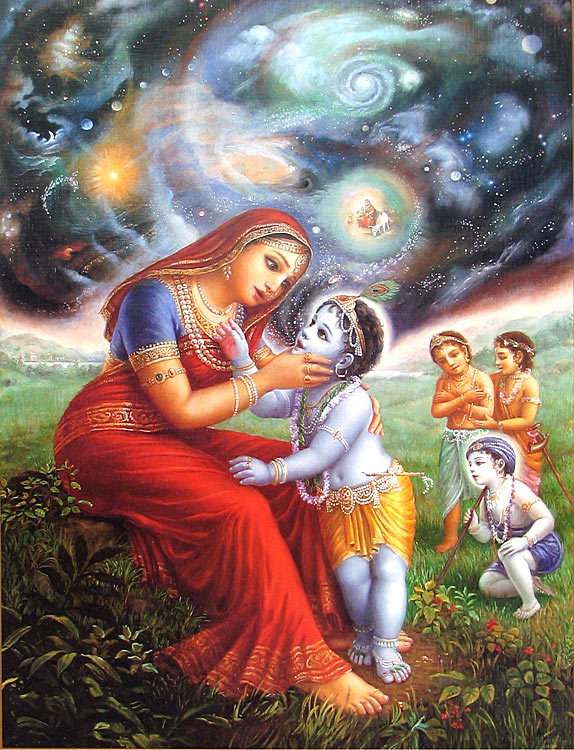
yashodakrishnaOne day when Rāma and the other little sons of the cowherds were playing, they reported to his mother, “Kṛṣṇa has eaten dirt.” Yaśodā took Krishna by the hand and scolded him, for his own good, and she said to him, seeing that his eyes were bewildered with fear, “Naughty boy, why have you secretly eaten dirt?” Kṛṣṇa said, “Mother, I have not eaten. They are all lying. If you think they speak the truth, look at my mouth yourself” “If that is the case, then open your mouth,” she said to the lord Hari [Vishnu], the God of unchallenged sovereignty who had in sport taken the form of a human child, and He opened his mouth.

She then saw in his mouth the whole eternal universe, and heaven, and the regions of the sky, and the orbit of the earth with its mountains, islands, and oceans; she saw the wind, and lightning, and the moon and stars, and the zodiac; and water and fire and air and space itself; she saw the vacillating senses, the mind, the elements, and the three strands of matter. She saw within the body of her son, in his gaping mouth, the whole universe in all its variety, with all the forms of life and time and nature and action and hopes, and her own village, and herself. Then she became afraid and confused, thinking, “Is this a dream, or an illusion wrought by a god? Or is it a delusion of my own perception? Or is it some portent of the natural powers of this little boy, my son? I bow down to the feet of the god, whose nature cannot be imagined or grasped by mind, heart, acts, or speech; he in whom all of this universe is inherent, impossible to fathom. The god is my refuge, he through whose power of delusion there arise in me such false beliefs as “I”, “This is my husband”, “This is my son”, “I am the wife of the village chieftain and all his wealth is mine, including these cow-herds and their wives and their wealth of cattle.”

When the cow-herd’s wife had come to understand the true essence in this way, the lord spread his magic illusion in the form of maternal affection. Instantly the cow-herd’s wife lost her memory of what had occurred and took her son on her lap. She was as she had been before, her heart flooded with even greater love. She considered Hari – whose greatness is extolled by the three Vedas and the Upaniṣads and the philosophies of Sāṅkhya and yoga and all the Sātvata texts – she considered him to be her son.

Bhāgavata Purāṇa 10.8.21-45,
translated by Wendy Doniger, Hindu Myths, 220-221     

Read the other Great Myths here


Discover more from Tim Miller

Subscribe to get the latest posts to your email.

2 responses

  1. […] story is of Young Krishna and the Universe in His Mouth. If, like me, you weren’t familiar with it then here is a quick summary and […]

    Liked by 1 person

  2. […] story is of Young Krishna and the Universe in His Mouth. If, like me, you weren’t familiar with it then here is a quick summary and explanation: A young […]

    Liked by 1 person

#223 – How to write two novels at the same time, with Charles Dickens Human Voices Wake Us

An episode from 1/10/23: Tonight we take a peek into the creative life of Charles Dickens (1812-1870). Through a handful of readings from Claire Tomalin’s biography of Dickens, we see how he was able to juggle, for almost a year, the writing of two novels for simultaneous serial publication. Then, thanks to a letter written by Fyodor Dostoevsky, who visited Dickens in London in 1862, we also hear Dickens admitting that his villains were better reflections of himself than his more lovable and generous characters. We also answer the question: what do David Copperfield and Jane Eyre have in common? Finally, we hear about the chance encounter Dickens had with a young fan in America, who grew up to become a novelist herself.Note: these readings from the life of Dickens were originally the first part of a longer episode, hence the brief mention of the second part, no longer included, and the abrupt ending here. Listeners will forgive these frayed edges. The best way to support the podcast is by leaving a review on Apple or Spotify, sharing it with others, or sending me a note on what you think. You can also order any of my books: Time and the River: From Columbine to the Invention of Fire, Notes from the Grid, To the House of the Sun, The Lonely Young & the Lonely Old, and Bone Antler Stone. I've also edited a handful of books in the S4N Pocket Poems series. I also have a YouTube channel where I share poems and excerpts from these books, mostly as YouTube shorts. Email me at humanvoiceswakeus1@gmail.com.
  1. #223 – How to write two novels at the same time, with Charles Dickens
  2. #222: Seamus Heaney – 10 Essential Poems
  3. #221: Volcanoes, Plagues & the Childhood of a Kabbalist
  4. #220: The working poor and a so-so murder show
  5. #219: When a paragraph changes your life
  6. #218: Poetry to Live By
  7. #217: Voices from 1900-1914
  8. #216: Poets, Prophets, Seeresses & Goddesses from Time & the River
  9. #215: 8 Favorite Poems from "Time and the River"
  10. #214: Two of the Best Poems You've Never Heard of (by William Cullen Bryant)

Discover more from Tim Miller

Subscribe now to keep reading and get access to the full archive.

Continue reading