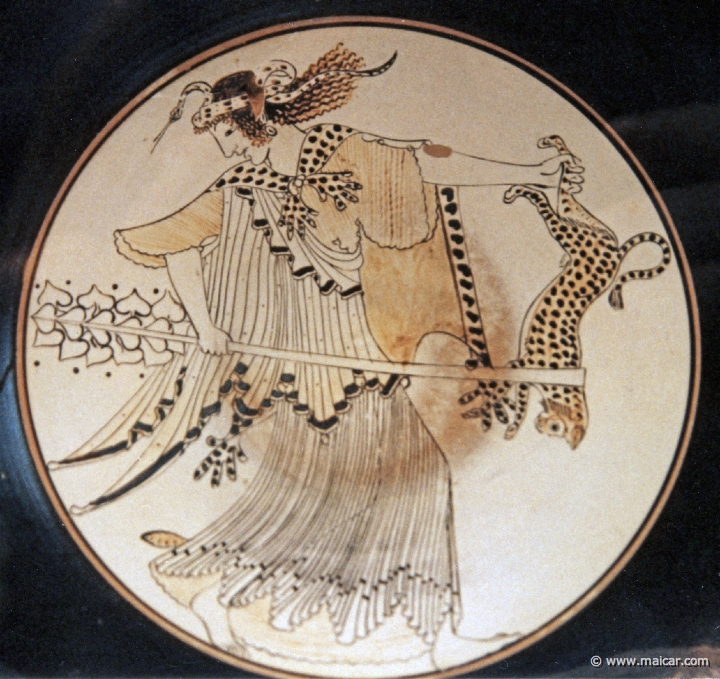
In ancient Thebes, the king, Pentheus, has refused to worship the god Dionysus; the god in turn has driven the women of Thebes into an ecstatic religious frenzy, as a messenger describes to the king:
Messenger: About that hour
when the sun lets loose its light to warm the earth,
our grazing herds of cows had just begun to climb
the path along the mountain ridge. Suddenly
I saw three companions of dancing women,
one led by Autonoë, the second captained
by your mother Agave, while Ino led the third.
There they lay in the deep sleep of exhaustion,
some resting on boughs of fir, others sleeping
where they fell, here and there among the oak leaves—
but all modestly and soberly, not, as you think,
drunk with wine, nor wandering, led astray
by the music of the flute, to hunt their Aphrodite
through the woods.
But your mother heard the lowing
of our horned herds, and springing to her feet,
gave a great cry to waken them from sleep.
And they too, rubbing the bloom of soft sleep
from their eyes, rose up lightly and straight—
a lovely sight to see: all as one,
the old women and the young and the unmarried girls.
First they let their hair fall loose, down
over their shoulders, and those whose straps had slipped
fastened their skins of fawn with writhing snakes
that licked their cheeks. Breasts swollen with milk,
new mothers who had left their babies behind at home
nestled gazelles and young wolves in their arms,
suckling them. Then they crowned their hair with leaves,
ivy and oak and flowering bryony. One woman
struck her thyrsus against a rock and a fountain
of cool water came bubbling up. Another drove
her fennel in the ground, and where it struck the earth,
at the touch of god, a spring of wine poured out.
Those who wanted milk scratched at the soil
with bare fingers and the white milk came welling up.
Pure honey spurted, streaming, from their wands.
If you had been there and seen these wonders for yourself,
you would have gone down on your knees and prayed
to the god you now deny.
We cowherds and shepherds
gathered in small groups, wondering and arguing
among ourselves at these fantastic things,
the awful miracles those women did.
But then a city fellow with the knack of words
rose to his feet and said: “All you who live
upon the pastures of the mountain, what do you say?
Shall we earn a little favor with King Pentheus
by hunting his mother Agave out of the revels?”
Falling in with his suggestion, we withdrew
and set ourselves in ambush, hidden by the leaves
among the undergrowth. Then at a signal
all the Bacchae whirled their wands for the revels
to begin. With one voice they cried aloud:
“Oh Iacchus! Son of Zeus!” “O Bromius!” they cried
until the beasts and all the mountains seemed
wild with divinity. And when they ran,
everything ran with them.
It happened, however,
that Agave ran near the ambush where I lay
concealed. Leaping up, I tried to seize her,
but she gave a cry: “Hounds who run with me,
men are hunting us down! Follow, follow me!
Use your wands for weapons.”
At this we fled
and barely missed being torn to pieces by the women.
Unarmed, they swooped down upon the herds of cattle
grazing there on the green of the meadow. And then
you could have seen a single woman with bare hands
tear a fat calf, still bellowing with fright,
in two, while others clawed the heifers to pieces.
There were ribs and cloven hooves scattered everywhere,
and scrapes smeared with blood hung from the fir trees.
And bulls, their raging fury gathered in their horns,
lowered their heads to charge, then fell, stumbling
to the earth, pulled down by hordes of women
and stripped of flesh and skin more quickly, sire,
than you could blink your royal eyes. Then,
carried up by their own speed, they flew like birds
across the spreading fields along Asopus’ stream
where most of all the ground is good for harvesting.
Like invaders they swooped on Hysiae
and on Erythrae in the foothills of Cithaeron.
Everything in sight they pillaged and destroyed.
They snatched the children from their homes. And when
they piled their plunder on their backs, it stayed in place,
untied. Nothing, neither bronze nor iron,
fell to the dark earth. Flames flickered
in their curls and did not burn them. Then the villagers,
furious at what the women did, took to arm.
And there, sire, was something terrible to see.
For the men’s spears were pointed and sharp, and yet
drew no blood, whereas the wands the women threw
inflicted wounds. And then the men ran,
routed by women! Some god, I say, was with them.
The Bacchae then returned where they had started,
by the springs the god had made, and washed their hands
while the snakes licked away the drops of blood
that dabbled their cheeks.
Whoever this god may be,
sire, welcome him to Thebes. For he is great
in many other ways as well. It was he,
or so they say, who gave to mortal men
the gift of lovely wine by which our suffering
is stopped. And if there is no god of wine,
there is no love, no Aphrodite either,
nor other pleasure left to me. Exit messenger.
Coryphaeus: I tremble
to speak the words of freedom before the tyrant.
But let truth be told: there is no god
greater than Dionysus.
– Euripides, The Bacchae,
translated by William Arrowsmith, lines 677-778