Had we but World enough, and Time,
This coyness Lady were no crime.
We would sit down, and think which way
To walk, and pass our long Loves Day.
Thou by the Indian Ganges side
Should’st Rubies find: I by the Tide
Of Humber would complain. I would
Love you ten years before the Flood:
And you should if you please refuse
Till the Conversion of the Jews.
My vegetable Love should grow
Vaster then Empires, and more slow.
An hundred years should go to praise
Thine Eyes, and on thy Forehead Gaze.
Two hundred to adore each Breast:
But thirty thousand to the rest.
An Age at least to every part,
And the last Age should show your Heart.
For Lady you deserve this State;
Nor would I love at lower rate.
But at my back I alwaies hear
Times winged Charriot hurrying near:
And yonder all before us lye
Desarts of vast Eternity.
Thy Beauty shall no more be found;
Nor, in thy marble Vault, shall sound
My ecchoing Song: then Worms shall try
That long preserv’d Virginity:
And your quaint Honour turn to dust;
And into ashes all my Lust.
The Grave’s a fine and private place,
But none I think do there embrace.
Now therefore, while the youthful glew
Sits on thy skin like morning dew,
And while thy willing Soul transpires
At every pore with instant Fires,
Now let us sport us while we may;
And now, like am’rous birds of prey,
Rather at once our Time devour,
Than languish in his slow-chapt pow’r.
Let us roll all our Strength, and all
Our sweetness, up into one Ball:
And tear our Pleasures with rough strife,
Thorough the Iron gates of Life.
Thus, though we cannot make our Sun
Stand still, yet we will make him run.

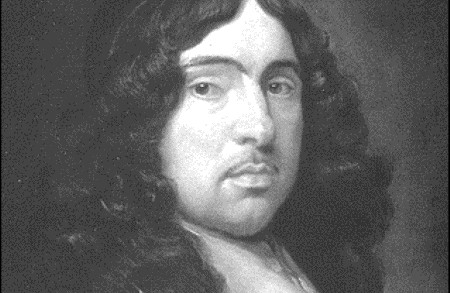
Andrew Marvell, 1621-1678 – “To His Coy Mistress” from Complete Poems


Discover more from Tim Miller

Subscribe to get the latest posts to your email.

3 responses

  1. it’s still incredible how modern the poem sounds, it could have been written in the last 20yrs

    Liked by 1 person

  2. I totally agree with you! I just presented it in a lecture at the university of the third age in my town

    Like

Leave a Reply

This site uses Akismet to reduce spam. Learn how your comment data is processed.

#230 – The mythology of the bear, and Byron gets apocalyptic Human Voices Wake Us

An episode from 5/18/26: Tonight I read about the bear in folklore and mythology from two books everybody should have on their shelves: the Taschen Book of Symbols and the Penguin Dictionary of Symbols. Browsing through either puts you in contact with our best stories and, with the Taschen book, some of our best artwork.Next, I read Lord Byron’s (1788-1824) apocalyptic poem Darkness from 1816. You can read more about the volcanic eruption that inspired poem, and produced the “year without summer,” here.Finally, I read a few passages on revelation and the religious experience from the rabbi, theologian and civil rights activist Abraham Joshua Heshel’s (1907-1962) God in Search of Man: A Philosophy of Judaism.The best way to support the podcast is by leaving a review on Apple or Spotify, sharing it with others, or sending me a note on what you think. You can also order any of my books: Time and the River: From Columbine to the Invention of Fire, Notes from the Grid, To the House of the Sun, The Lonely Young & the Lonely Old, and Bone Antler Stone. I've also edited a handful of books in the S4N Pocket Poems series. I also have a YouTube channel where I share poems and excerpts from these books, mostly as YouTube shorts.Email me at humanvoiceswakeus1@gmail.com.
  1. #230 – The mythology of the bear, and Byron gets apocalyptic
  2. #229 : Mother Earth and myths of mining and agriculture
  3. #228 – What Ted Bundy did on July 14, 1974
  4. #227 – The Great Fire of London and the destruction of Jerusalem
  5. #226: The Vitality and terror of cities
  6. #225 – The invention of the wheel, and the power of storytelling
  7. #224: Let's talk about William Blake
  8. #223 – How to write two novels at the same time, with Charles Dickens
  9. #222: Seamus Heaney – 10 Essential Poems
  10. #221: Volcanoes, Plagues & the Childhood of a Kabbalist

Discover more from Tim Miller

Subscribe now to keep reading and get access to the full archive.

Continue reading