IMPRIMIS – My departed Shade I trust
To Heav’n – My Body to the silent Dust;
My Name to publick Censure I submit,
To be dispos’d of as the World thinks fit;
My Vice and Folly let Oblivion close,
The World already is o’erstock’d with those;
My Wit I give, as Misers give their Store,
To those who think they had enough before.
Bestow my Patience to compose the Lives
Of slighted Virgins and neglected Wives;
To modish Lovers I resign my Truth,
My cool Reflexion to unthinking Youth;
And some Good-nature give (’tis my Desire)
To surly Husbands, as their Needs require;
And first discharge my Funeral – and then
To the small Poets I bequeath my Pen.
Let a small Sprig (true Emblem of my Rhyme)
Of blasted Laurel on my Hearse recline;
Let some grave Wight, that struggles for Renown,
By chanting Dirges through a Market-Town,
With gentle Step precede the solemn Train;
A broken Flute upon his Arm shall lean.
Six comick Poets may the Corse surround,
And All Free-holders, if they can be found:
Then follow next the melancholy Throng,
As shrewd Instructors, who themselves are wrong.
The Virtuoso, rich in Sun-dry’d Weeds,
The Politician, whom no Mortal heeds,
The silent Lawyer, chamber’d all the Day,
And the stern Soldier that receives no Pay.
But stay – the Mourners shou’d be first our Care,
Let the freed Prentice lead the Miser’s Heir;
Let the young Relict wipe her mournful Eye,
And widow’d Husbands o’er their Garlick cry.
All this let my Executors fulfil,
And rest assur’d that this is Mira’s Will,
Who was, when she these Legacies design’d,
In Body healthy, and compos’d in Mind.

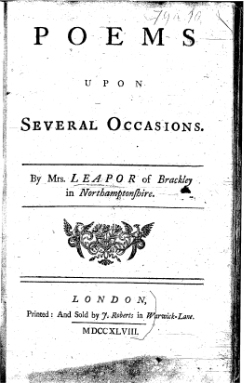
Mary Leapor, 1722-1746 – “Mira’s Will” from The New Oxford Book of Eighteenth-Century Verse


Discover more from Tim Miller

Subscribe to get the latest posts to your email.

Leave a Reply

This site uses Akismet to reduce spam. Learn how your comment data is processed.

#225 – The invention of the wheel, and the power of storytelling Human Voices Wake Us

An episode from 4/13/26: Tonight, I read about the invention of the wheel and what it meant for the earliest communities of Europe and the Eurasian steppes, from David Anthony’s The Horse, the Wheel, and Language.After this, a few passages from Norman Longmate’s How We Lived Then: A History of Everyday Life During the Second World War tells the story of gasoline rationing in England during the war, and the sometimes-comical lengths people went to hoard the fuel they could get a hold of.Finally, passages from S. Y. Agnon’s Days of Awe: A Treasury of Jewish Wisdom for Reflection, Repentance, and Renewal on the High Holy Days and Gershom Scholem’s Major Trends in Jewish Mysticism illustrate the power of language and storytelling in the Jewish tradition.The best way to support the podcast is by leaving a review on Apple or Spotify, sharing it with others, or sending me a note on what you think. You can also order any of my books: Time and the River: From Columbine to the Invention of Fire, Notes from the Grid, To the House of the Sun, The Lonely Young & the Lonely Old, and Bone Antler Stone. I've also edited a handful of books in the S4N Pocket Poems series. I also have a YouTube channel where I share poems and excerpts from these books, mostly as YouTube shorts.Email me at humanvoiceswakeus1@gmail.com.
  1. #225 – The invention of the wheel, and the power of storytelling
  2. #224: Let's talk about William Blake
  3. #223 – How to write two novels at the same time, with Charles Dickens
  4. #222: Seamus Heaney – 10 Essential Poems
  5. #221: Volcanoes, Plagues & the Childhood of a Kabbalist
  6. #220: The working poor and a so-so murder show
  7. #219: When a paragraph changes your life
  8. #218: Poetry to Live By
  9. #217: Voices from 1900-1914
  10. #216: Poets, Prophets, Seeresses & Goddesses from Time & the River

Discover more from Tim Miller

Subscribe now to keep reading and get access to the full archive.

Continue reading