Under branches of white lilac 
They crop the wet grass just before dawn.
They move smokily through the half-light, smudge pots
Pulsing against a thick morning frost.
My watch glows like a small, improbable moon. Six o’clock.
I have been driving into the dark too long.

I pull to the side of the road.
I am a branch, a stone. The lambs are not aware of me.
They have been fading into the hillside
Like shadows that have peopled someone’s fever
In the shut room of a dilapidated farmhouse
Where the walls reiterate a spray of honeysuckle.

They ignore one another. They are blanketed with thistles,
A little out of sorts in this shabby light.
Five or six of them are wandering through a peach orchard,
Not even aware of my personal squalor.
What stumbles from their tongues is never music;
It is the echo of a badly damaged shell.

Now they are moving by a ditch of rainwater,
Inspected for flaws in the foggy mirror.
I walk into the field, I am not afraid of them –
They scatter like the last edges of a sickness.
The sun has begun to enlarge its tawny fleeces
At the expense of no one in particular.

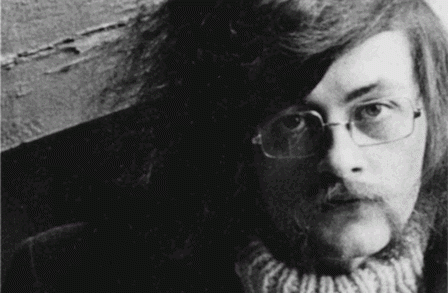
Thomas James, 1946-1974 – “Lambs” from Letters to a Stranger

Discover more from Tim Miller

Subscribe to get the latest posts to your email.

Leave a Reply

This site uses Akismet to reduce spam. Learn how your comment data is processed.

#225 – The invention of the wheel, and the power of storytelling Human Voices Wake Us

An episode from 4/13/26: Tonight, I read about the invention of the wheel and what it meant for the earliest communities of Europe and the Eurasian steppes, from David Anthony’s The Horse, the Wheel, and Language.After this, a few passages from Norman Longmate’s How We Lived Then: A History of Everyday Life During the Second World War tells the story of gasoline rationing in England during the war, and the sometimes-comical lengths people went to hoard the fuel they could get a hold of.Finally, passages from S. Y. Agnon’s Days of Awe: A Treasury of Jewish Wisdom for Reflection, Repentance, and Renewal on the High Holy Days and Gershom Scholem’s Major Trends in Jewish Mysticism illustrate the power of language and storytelling in the Jewish tradition.The best way to support the podcast is by leaving a review on Apple or Spotify, sharing it with others, or sending me a note on what you think. You can also order any of my books: Time and the River: From Columbine to the Invention of Fire, Notes from the Grid, To the House of the Sun, The Lonely Young & the Lonely Old, and Bone Antler Stone. I've also edited a handful of books in the S4N Pocket Poems series. I also have a YouTube channel where I share poems and excerpts from these books, mostly as YouTube shorts.Email me at humanvoiceswakeus1@gmail.com.
  1. #225 – The invention of the wheel, and the power of storytelling
  2. #224: Let's talk about William Blake
  3. #223 – How to write two novels at the same time, with Charles Dickens
  4. #222: Seamus Heaney – 10 Essential Poems
  5. #221: Volcanoes, Plagues & the Childhood of a Kabbalist
  6. #220: The working poor and a so-so murder show
  7. #219: When a paragraph changes your life
  8. #218: Poetry to Live By
  9. #217: Voices from 1900-1914
  10. #216: Poets, Prophets, Seeresses & Goddesses from Time & the River

Discover more from Tim Miller

Subscribe now to keep reading and get access to the full archive.

Continue reading