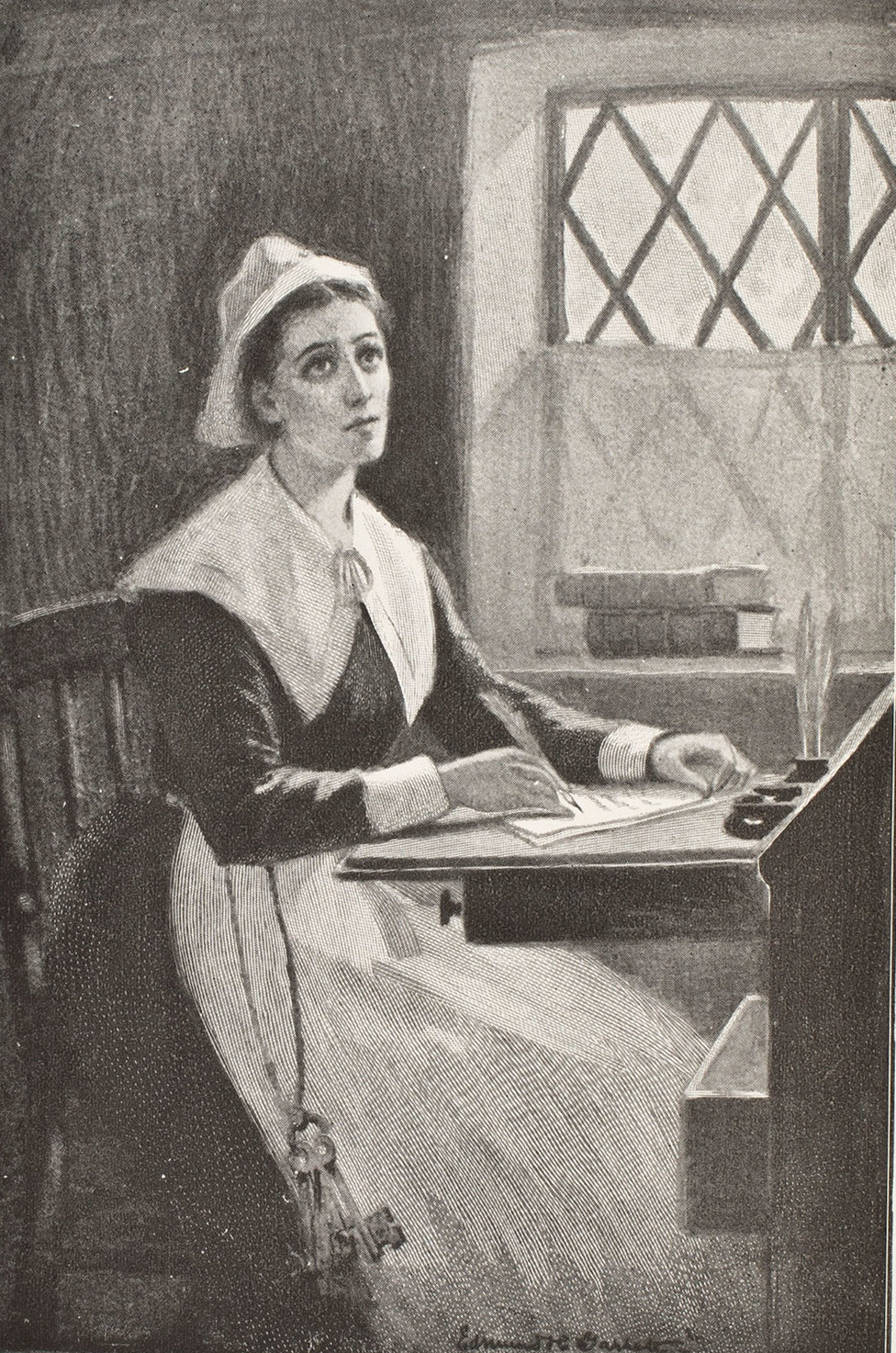
Thou ill-form’d offspring of my feeble brain,
Who after birth didst by my side remain,
Till snatched from thence by friends, less wise than true,
Who thee abroad, expos’d to publick view,
Made thee in raggs, halting to th’ press to trudge,
Where errors were not lessened (all may judg).
At thy return my blushing was not small,
My rambling brat (in print) should mother call,
I cast thee by as one unfit for light,
Thy Visage was so irksome in my sight;
Yet being mine own, at length affection would
Thy blemishes amend, if so I could:
I wash’d thy face, but more defects I saw,
And rubbing off a spot, still made a flaw.
I stretched thy joynts to make thee even feet,
Yet still thou run’st more hobling then is meet;
In better dress to trim thee was my mind,
But nought save home-spun Cloth, i’ th’ house I find.
In this array ’mongst Vulgars mayst thou roam.
In Criticks hands, beware thou dost not come;
And take thy way where yet thou art not known,
If for thy Father askt, say, thou hadst none:
And for thy Mother, she alas is poor,
Which caus’d her thus to send thee out of door.

Anne Bradstreet, c. 1612-1672 – “The Author to Her Book” from The Poems


Discover more from Tim Miller

Subscribe to get the latest posts to your email.

One response

  1. Jennifer Mugrage Avatar
    Jennifer Mugrage

    I love this one.

    Like

Leave a Reply

This site uses Akismet to reduce spam. Learn how your comment data is processed.

#225 – The invention of the wheel, and the power of storytelling Human Voices Wake Us

An episode from 4/13/26: Tonight, I read about the invention of the wheel and what it meant for the earliest communities of Europe and the Eurasian steppes, from David Anthony’s The Horse, the Wheel, and Language.After this, a few passages from Norman Longmate’s How We Lived Then: A History of Everyday Life During the Second World War tells the story of gasoline rationing in England during the war, and the sometimes-comical lengths people went to hoard the fuel they could get a hold of.Finally, passages from S. Y. Agnon’s Days of Awe: A Treasury of Jewish Wisdom for Reflection, Repentance, and Renewal on the High Holy Days and Gershom Scholem’s Major Trends in Jewish Mysticism illustrate the power of language and storytelling in the Jewish tradition.The best way to support the podcast is by leaving a review on Apple or Spotify, sharing it with others, or sending me a note on what you think. You can also order any of my books: Time and the River: From Columbine to the Invention of Fire, Notes from the Grid, To the House of the Sun, The Lonely Young & the Lonely Old, and Bone Antler Stone. I've also edited a handful of books in the S4N Pocket Poems series. I also have a YouTube channel where I share poems and excerpts from these books, mostly as YouTube shorts.Email me at humanvoiceswakeus1@gmail.com.
  1. #225 – The invention of the wheel, and the power of storytelling
  2. #224: Let's talk about William Blake
  3. #223 – How to write two novels at the same time, with Charles Dickens
  4. #222: Seamus Heaney – 10 Essential Poems
  5. #221: Volcanoes, Plagues & the Childhood of a Kabbalist
  6. #220: The working poor and a so-so murder show
  7. #219: When a paragraph changes your life
  8. #218: Poetry to Live By
  9. #217: Voices from 1900-1914
  10. #216: Poets, Prophets, Seeresses & Goddesses from Time & the River

Discover more from Tim Miller

Subscribe now to keep reading and get access to the full archive.

Continue reading