Was it for this
That one, the fairest of all rivers, loved
To blend his murmurs with my nurse’s song,
And from his alder shades and rocky falls,
And from his fords and shallows, sent a voice
That flowed along my dreams? For this didst thou,
O Derwent, travelling over the green plains
Near my ‘sweet birthplace’, didst thou, beauteous stream,
Make ceaseless music through the night and day,
Which with its steady cadence tempering
Our human waywardness, composed my thoughts
To more than infant softness, giving me
Among the fretful dwellings of mankind,
A knowledge, a dim earnest, of the calm
Which Nature breathes among the hills and groves?
When, having left his mountains, to the towers
Of Cockermouth that beauteous river came,
Behind my father’s house he passed, close by,
Along the margin of our terrace walk.
He was a playmate whom we dearly loved:
Oh, many a time have I, a five years’ child,
A naked boy, in one delightful rill,
A little mill-race severed from his stream,
Made one long bathing of a summer’s day,
Basked in the sun, and plunged, and basked again,
Alternate, all a summer’s day, or coursed
Over the sandy fields, leaping through groves
Of yellow grunsel; or, when crag and hill,
The woods, and distant Skiddaw’s lofty height,
Were bronzed with a deep radiance, stood alone
Beneath the sky, as if I had been born
On Indian plains, and from my mother’s hut
Had run abroad in wantonness to sport,
A naked savage, in the thunder-shower.

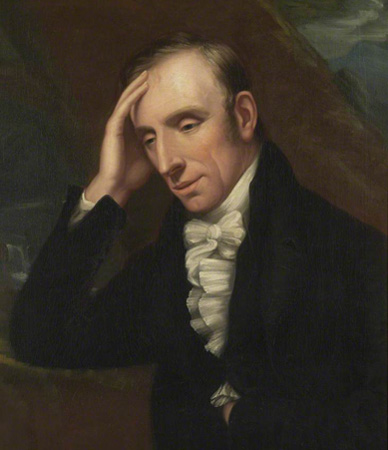
William Wordsworth, 1770-1850 – Book 1 of The Prelude from The Major Works

Discover more from Tim Miller

Subscribe to get the latest posts to your email.

Leave a Reply

This site uses Akismet to reduce spam. Learn how your comment data is processed.

#225 – The invention of the wheel, and the power of storytelling Human Voices Wake Us

An episode from 4/13/26: Tonight, I read about the invention of the wheel and what it meant for the earliest communities of Europe and the Eurasian steppes, from David Anthony’s The Horse, the Wheel, and Language.After this, a few passages from Norman Longmate’s How We Lived Then: A History of Everyday Life During the Second World War tells the story of gasoline rationing in England during the war, and the sometimes-comical lengths people went to hoard the fuel they could get a hold of.Finally, passages from S. Y. Agnon’s Days of Awe: A Treasury of Jewish Wisdom for Reflection, Repentance, and Renewal on the High Holy Days and Gershom Scholem’s Major Trends in Jewish Mysticism illustrate the power of language and storytelling in the Jewish tradition.The best way to support the podcast is by leaving a review on Apple or Spotify, sharing it with others, or sending me a note on what you think. You can also order any of my books: Time and the River: From Columbine to the Invention of Fire, Notes from the Grid, To the House of the Sun, The Lonely Young & the Lonely Old, and Bone Antler Stone. I've also edited a handful of books in the S4N Pocket Poems series. I also have a YouTube channel where I share poems and excerpts from these books, mostly as YouTube shorts.Email me at humanvoiceswakeus1@gmail.com.
  1. #225 – The invention of the wheel, and the power of storytelling
  2. #224: Let's talk about William Blake
  3. #223 – How to write two novels at the same time, with Charles Dickens
  4. #222: Seamus Heaney – 10 Essential Poems
  5. #221: Volcanoes, Plagues & the Childhood of a Kabbalist
  6. #220: The working poor and a so-so murder show
  7. #219: When a paragraph changes your life
  8. #218: Poetry to Live By
  9. #217: Voices from 1900-1914
  10. #216: Poets, Prophets, Seeresses & Goddesses from Time & the River

Discover more from Tim Miller

Subscribe now to keep reading and get access to the full archive.

Continue reading