Far out of sight forever stands the sea,
Bounding the land with pale tranquillity.
When a small child, I watched it from a hill
At thirty miles or more. The vision still
Lies in the eye, soft blue and far away:
The rain has washed the dust from April day;
Paint-brush and lupine lie against the ground;
The wind above the hill-top has the sound
Of distant water in unbroken sky;
Dark and precise the little steamers ply –
Firm in direction they seem not to stir.
That is illusion. The artificer
Of quiet, distance holds me in a vise
And holds the ocean steady to my eyes.

Once when I rounded Flattery, the sea
Hove its loose weight like sand to tangle me
Upon the washing deck, to crush the hull;
Subsiding, dragged flesh at the bone. The skull
Felt the retreating wash of dreaming hair.
Half drenched in dissolution, I lay bare.
I scarcely pulled myself erect; I came
Back slowly, slowly knew myself the same.
That was the ocean. From the ship we saw
Gray whales for miles: the long sweep of the jaw,
The blunt head plunging clean above the wave.
And one rose in a tent of sea and gave
A darkening shudder; water fell away;
The whale stood shining, and then sank in spray.

A landsman, I. The sea is but a sound.
I would be near it on a sandy mound,
And hear the steady rushing of the deep
While I lay stinging in the sand with sleep.
I have lived inland long. The land is numb.
It stands beneath the feet, and one may come
Walking securely, till the sea extends
Its limber margin, and precision ends.
By night a chaos of commingling power,
The whole Pacific hovers hour by hour.
The slow Pacific swell stirs on the sand,
Sleeping to sink away, withdrawing land,
Heaving and wrinkled in the moon, and blind;
Or gathers seaward, ebbing out of mind.

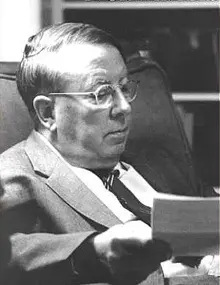
Yvor Winters, 1900-1968 – “The Slow Pacific Swell” from Selected Poems

Discover more from Tim Miller

Subscribe to get the latest posts to your email.

Leave a Reply

This site uses Akismet to reduce spam. Learn how your comment data is processed.

#225 – The invention of the wheel, and the power of storytelling Human Voices Wake Us

An episode from 4/13/26: Tonight, I read about the invention of the wheel and what it meant for the earliest communities of Europe and the Eurasian steppes, from David Anthony’s The Horse, the Wheel, and Language.After this, a few passages from Norman Longmate’s How We Lived Then: A History of Everyday Life During the Second World War tells the story of gasoline rationing in England during the war, and the sometimes-comical lengths people went to hoard the fuel they could get a hold of.Finally, passages from S. Y. Agnon’s Days of Awe: A Treasury of Jewish Wisdom for Reflection, Repentance, and Renewal on the High Holy Days and Gershom Scholem’s Major Trends in Jewish Mysticism illustrate the power of language and storytelling in the Jewish tradition.The best way to support the podcast is by leaving a review on Apple or Spotify, sharing it with others, or sending me a note on what you think. You can also order any of my books: Time and the River: From Columbine to the Invention of Fire, Notes from the Grid, To the House of the Sun, The Lonely Young & the Lonely Old, and Bone Antler Stone. I've also edited a handful of books in the S4N Pocket Poems series. I also have a YouTube channel where I share poems and excerpts from these books, mostly as YouTube shorts.Email me at humanvoiceswakeus1@gmail.com.
  1. #225 – The invention of the wheel, and the power of storytelling
  2. #224: Let's talk about William Blake
  3. #223 – How to write two novels at the same time, with Charles Dickens
  4. #222: Seamus Heaney – 10 Essential Poems
  5. #221: Volcanoes, Plagues & the Childhood of a Kabbalist
  6. #220: The working poor and a so-so murder show
  7. #219: When a paragraph changes your life
  8. #218: Poetry to Live By
  9. #217: Voices from 1900-1914
  10. #216: Poets, Prophets, Seeresses & Goddesses from Time & the River

Discover more from Tim Miller

Subscribe now to keep reading and get access to the full archive.

Continue reading