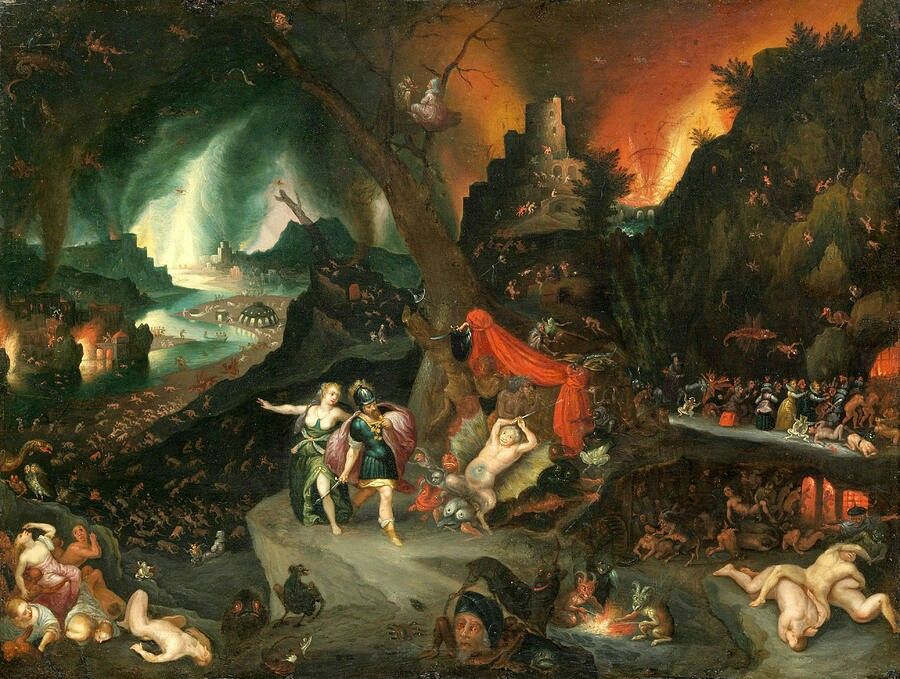
tartarus

Read the other Great Myths here

Here, in order, are the ends and springs
Of gloomy earth and misty Tartarus,
And of the barren sea and starry heaven,
Murky and awful, loathed by the very gods.
There is the yawning mouth of hell, and if
A man should find himself inside the gates,
He would not reach the bottom for a year;
Gust after savage gust would carry him
Now here, now there. Even the deathless gods
Find this an awesome mystery. Here, too,
Is found the fearsome home of dismal Night
Hidden in dark blue clouds. Before her house
The son of Iapetos, unshakable,
Holds up broad heaven with his head and hands
Untiring, in the place where Night and Day
Approach and greet each other, as they cross
The great bronze threshold. When the one goes in,
The other leaves; never are both at home,
But always one, outside, crosses the earth,
The other waits at home until her hour
For journeying arrives. The one brings light
All-seeing, to the earth, but deadly Night,
The other, hidden in dark clouds, brings Sleep,
Brother of Death, and carries him in her arms.
There live the children of dark Night, dread gods,
Sleep and his brother Death. The shining Sun
Has never looked upon them with his rays
Not going up to heaven, nor coming back.
The one of them is kind to men and goes
Peacefully over earth and the sea’s broad back;
The other’s heart is iron; in his breast
Is pitiless bronze: if she should touch a man,
That man is his. And even to the gods
Who are immortal, Death is an enemy.

– Hesiod, Theogony, tr. Dorothea Wender


Discover more from Tim Miller

Subscribe to get the latest posts to your email.

#212: The Most Popular Story in Ancient India Human Voices Wake Us

An episode from 1/12/2026: Tonight, I read from the oldest religious poetry from India, the collection of 1,028 ritual hymns known as the The Rig Veda. Specifically, I read from the most popular story found there, the defeat of the serpent Vrtra by the god Indra and the freeing of the waters of the world.I begin by telling the story briefly and then sharing examples of the short references to it that are scattered all over the Rig Veda (from hymns 1.51, 1.56, 1.57, 2.19, 4.17, 4.30), which in themselves are indications as to how well-known the story was. Finally, I read a handful of hymns (1.32, 1.80, 4.19) in their entirety that tell the story in different ways.The translation and commentary I read from is by Stephanie Jamison and Joel Brereton; it took years to find a good and decently priced used copy of these volumes, but I would recommend them to anyone interested in Hinduism, poetry, or religion.The best way to support the podcast is by leaving a review on Apple or Spotify, sharing it with others, or sending me a note on what you think. You can also order any of my books: Time and the River: From Columbine to the Invention of Fire, due out next year, is now available for preorder. Other books include Notes from the Grid, To the House of the Sun, The Lonely Young & the Lonely Old, and Bone Antler Stone. I've also edited a handful of books in the S4N Pocket Poems series.Email me at humanvoiceswakeus1@gmail.com.
  1. #212: The Most Popular Story in Ancient India
  2. #211: Who Was William Cullen Bryant?
  3. #210: Memories & Legends of William Shakespeare
  4. #209 – Being a Jew in 1900, Being a Jew Now
  5. #208: Bach & God
  6. #207 – Death, the Gods, and Endless Life in Ancient Egypt
  7. #206 – The Discovery of Indo-European Languages – 1876
  8. #205: Learning to Read, c. 2000 BCE
  9. #204: Walt Whitman's "Crossing Brooklyn Ferry," 1856
  10. #203: Bruce Springsteen Talks About "Nebraska" – 1984

Discover more from Tim Miller

Subscribe now to keep reading and get access to the full archive.

Continue reading