Read the other Great Myths here
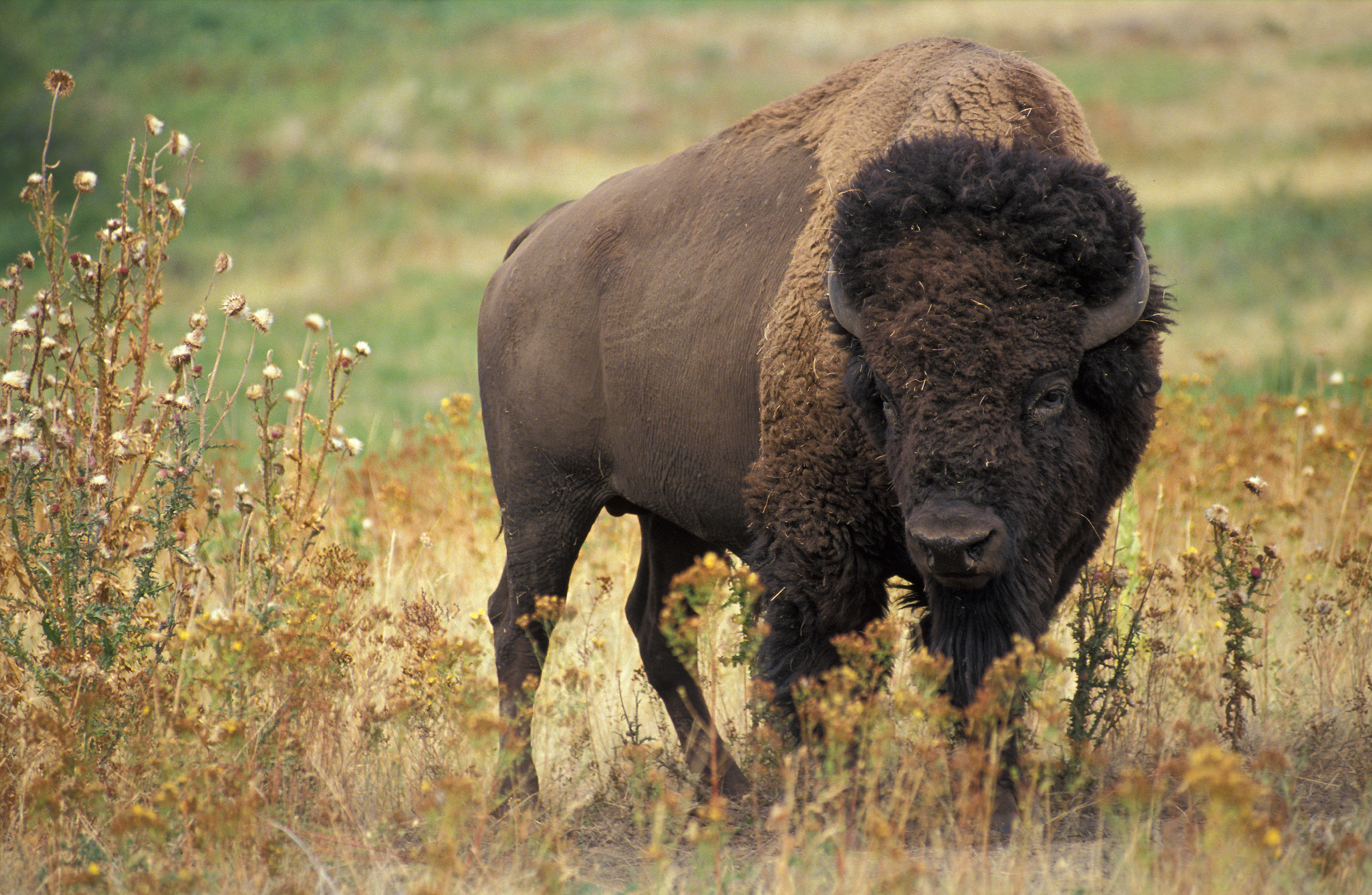
George Bird Grinnell’s classic account (from 1892) of the origin of the Blackfoot Buffalo Dance. It culminates with the buffalo freely offering themselves to the Blackfoot tribe, but only after teaching them the dance that will resurrect the buffalo herds:
The people had built a great pis’kun [a buffalo trap leading to a drop or cliff that the buffalo were driven over], very high and strong, so that no buffalo could escape; but somehow the buffalo would not jump over the cliff. When driven toward it, they would run nearly to the edge, and then, swerving to the right or left, they would go down the sloping hills and cross the valley in safety. So the people were hungry, and began to starve.
One morning, early, a young woman went to get water, and she saw a herd of buffalo feeding on the prairie, right on the edge of the cliff above the pis’kun. “Oh!” she cried out, “if you will only jump off into the pis’kun, I will marry one of you.” This she said for fun, not meaning it, and great was her wonder when she saw the buffalo come jumping, tumbling, falling over the cliff.
Now the young woman was scared, for a big bull with one bound cleared the pis’kun walls and came toward her. “Come,” he said, taking hold of her arm. “No, no!” she replied pulling back. “But you said if the buffalo would jump over, you would marry one; see, the pis’kun is filled.” And without more talk he led her up over the bluff, and out on to the prairie.
When the people had finished killing the buffalo and cutting up the meat, they missed this young woman, and her relations were very sad, because they could not find her. Then her father took his bow and quiver, and said, “I will go and find her.” And he went up over the bluff and out on the prairie.
After he had travelled some distance he came to a wallow, and a little way off saw a herd of buffalo. While sitting by the wallow,—for he was tired—and thinking what he should do, a magpie came and lit near him. “Ha! Ma-me-at-si-kim-i,” he said, “you are a beautiful bird; help me. Look everywhere as you travel about, and if you see my daughter, tell her, ‘Your father waits by the wallow.’” The magpie flew over by the herd of buffalo, and seeing the young woman, he lit on the ground near her, and commenced picking around, turning his head this way and that way, and, when close to her, he said, “Your father waits by the wallow.” “Sh-h-h! sh-h-h!” replied the girl, in a whisper, looking around scared, for her bull husband was sleeping near by. “Don’t speak so loud. Go back and tell him to wait.”
“Your daughter is over there with the buffalo. She says ‘wait!’” said the magpie, when he had flown back to the man.
By and by the bull awoke, and said to his wife, “Go and get me some water.” Then the woman was glad, and taking a horn from his head she went to the wallow. “Oh, why did you come?” she said to her father. “You will surely be killed.”
“I came to take my daughter home; come, let us hurry.”
“No, no!” she replied; “not now. They would chase us and kill us. Wait till he sleeps again, and I will try to get away,” and, filling the horn with water, she went back.
The bull drank a swallow of the water. “Ha!” said he, “a person is close by here.”
“No one,” replied the woman; but her heart rose up.
The bull drank a little more, and then he stood up and bellowed, “Bu-u-u! m-m-ah-oo!” Oh, fearful sound! Up rose the bulls, raised their short tails and shook them, tossed their great heads, and bellowed back. Then they pawed the dirt, rushed about here and there, and coming to the wallow, found that poor man. There they trampled him with their great hoofs, hooked him and trampled him again, and soon not even a small piece of his body could be seen.
Then his daughter cried, “Oh! ah! Ni-nah-ah! Oh! ah! Ni-nah-ah!” (My father! My father!) “Ah!” said her bull husband, “you mourn for your father. You see now how it is with us. We have seen our mothers, fathers, many of our relations, hurled over the rocky walls, and killed for food by your people. But I will pity you. I will give you one chance. If you can bring your father to life, you and he can go back to your people.”
Then the woman said to the magpie: “Pity me. Help me now; go and seek in the trampled mud; try and find a little piece of my father’s body, and bring it to me.”
The magpie flew to the place. He looked in every hole, and tore up the mud with his sharp nose. At last he found something white; he picked the mud from around it, and then pulling hard, he brought out a joint of the backbone, and flew with it back to the woman.
She placed it on the ground, covered it with her robe, and then sang. Removing the robe, there lay her father’s body as if just dead. Once more she covered it with the robe and sang, and when she took away the robe, he was breathing, and then he stood up. The buffalo were surprised; the magpie was glad, and flew round and round, making a great noise.
“We have seen strange things this day,” said her bull husband. “He whom we trampled to death, even into small pieces, is alive again. The people’s medicine is very strong. Now, before you go, we will teach you our dance and our song. You must not forget them.” 1 When the dance was over, the bull said: “Go now to your home, and do not forget what you have seen. Teach it to the people. The medicine shall be a bull’s head and a robe. All the persons who are to be ‘Bulls’ shall wear them when they dance.”
Great was the joy of the people, when the man returned with his daughter. He called a council of the chiefs, and told them all that had happened. Then the chiefs chose certain young men, and this man taught them the dance and song of the bulls, and told them what the medicine should be. This was the beginning of the I-kun-uh’-kah-tsi.


