Read the other Great Myths here
Thor went out across Midgard having assumed the appearance of a young boy, and arrived one evening at nightfall at a certain giant’s; his name was Hymir. Thor stayed there as a guest for the night. And at dawn Hymir got up and dressed and got ready to row out to sea fishing. And Thor sprang up and was soon ready and asked Hymir to let him row out to sea with him. But Hymir said there would not be much advantage in having him along since he was small and just a youth.
“And you’ll get cold if I stay out as long and as far as I am used to do.”
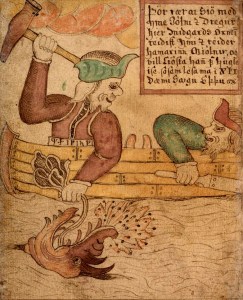
But Thor said he need not hesitate to row out from shore since it was not certain whether it would be he that would first beg to row back; and Thor got angry with the giant so that he was on the point of letting the hammer crash down on him straight away, but he decided to hold back since he was planning to try his strength elsewhere. He asked Hymir what they were to use as bait, but Hymir told him to get his own bait. Then Thor went off to where he could see a certain herd of oxen belonging to Hymir. He took the biggest ox, called Himinhriot, and tore off its head and took it down to the sea. Hymir had now launched the boat. Thor went aboard and took his seat in the well of the boat, took two oars and rowed, and Hymir thought there was some impetus from his rowing. Hymir was rowing forward in the bows and the rowing progressed fast. Then Hymir said they had reached the fishing ground where he usually sat catching flat fish, but Thor said he wanted to row much further, and they did another spurt of rowing. Then Hymir said they had got so far out that it was dangerous to be further out because of the Midgard serpent. But Thor said he would row on a bit and did so, but Hymir was then very unhappy. And when Thor had shipped his oars, he got out a line that was pretty strong, and the hook was no smaller or less mighty-looking. On to this hook Thor fastened the ox-head and threw it overboard, and the hook went to the bottom. And then it is true to say that Thor fooled the Midgard serpent no less than Utgarda-Loki had made a laughing-stock of Thor when he was lifting the serpent up with his hand. The Midgard serpent stretched its mouth round the ox-head and the hook stuck into the roof of the serpent’s mouth. And when the serpent felt this, it jerked away so hard that both Thor’s fists banged down on the gunwale. Then Thor got angry and summoned up his As-strength, pushed down so hard that he forced both feet through the boat and braced them against the sea-bed, and then hauled the serpent up to the gunwale. And one can claim that a person does not know what a horrible sight is who did not get to see how Thor fixed his eyes on the serpent, and the serpent stared back up at him spitting poison. It is said that then the giant Hymir changed colour, went pale, and panicked when he saw the serpent and how the sea flowed out and in over the boat. And just at the moment when Thor was grasping his hammer and lifting it in the air, the giant fumbled at his bait-knife and cut Thor’s line from the gunwale, and the serpent sank into the sea. But Thor threw his hammer after it, and they say that he struck off its head by the sea-bed. But I think in fact the contrary is correct to report to you that the Midgard serpent lives still and lies in the encircling sea. But Thor swung his fist and struck at Hymir’s ear so that he plunged overboard and one could see the soles of his feet. But Thor waded ashore.
– from the “Gylfaginning” in the Prose Edda,
translated by Anthony Faulkes, Edda, 46-47


