Read the other Great Myths here
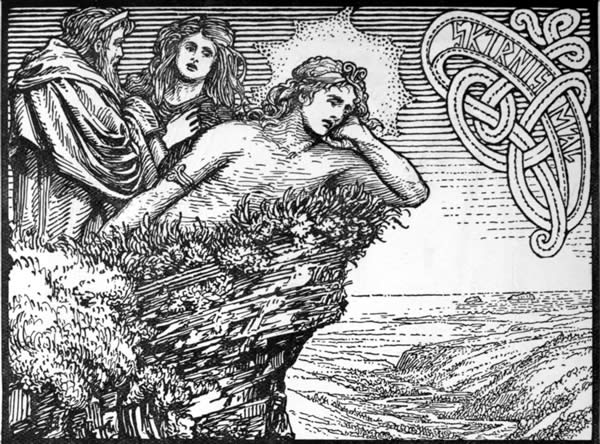
[High said:]“There was someone called Gymir, and his wife Aurboda. She was of the race of mountain-giants. Gerd is their daughter, the most beautiful of all women. It happened one day that Freyr had gone into Hlidskialf and was looking over all worlds, and when he looked to the north he saw on a certain homestead a large and beautiful building, and to this building went a woman, and when she lifted her arms and opened the door for herself, light was shed from her arms over both sky and sea, and all worlds were made bright by her. And his punishment for his great presumption in having sat in that holy seat was that he went away full of grief. And when he got home he said nothing, he neither slept nor drank; no one dared to try to speak with him. Then Niord sent for Freyr’s servant Skirnir, and bade him go to Freyr and try to get him to talk and ask who he was so angry with that he would not speak to anyone. Skirnir said he would go though he was not keen, and said unpleasant answers were to be expected from him. And when he got to Freyr he asked why Freyr was so downcast and would not speak to anyone. Then Freyr replied and said he had seen a beautiful woman and for her sake he was so full of grief that he would not live long if he were not to have her.
“ ‘And now you must go and ask for her hand on my behalf and bring her back here whether her father is willing or not, and I shall reward you well for it.’
“Then Skirnir replied, saying that he would undertake the mission, but Freyr must give him his sword. This was such a good sword that it would fight on its own. But Freyr did not let the lack of that be an obstacle and gave him the sword. Then Skirnir went and asked for the woman’s hand for him and received the promise from her, and nine nights later she was to go to the place called Barey and enter into marriage with Freyr. But when Skirnir told Freyr the result of his errand he said this:
‘Long is a night, long is a second, how can I suffer for three? Often has a month seemed shorter to me than half this wedding-eve.’
“This is the reason for Freyr so being unarmed when he fought Beli, killing him with a stag’s antler.”
Then spoke Gangleri: “It is very strange that such a prince as Freyr should want to give away his sword when he did not have another that was as good! This would have been a terrible handicap for him when he fought with the one called Beli. I dare swear by my faith that he must then have regretted this gift.”
Then High replied: “It did not matter much when he and Beli met. Freyr could have killed him with his fist. There will come a time when Freyr will find being without the sword a greater disadvantage when Muspell’s sons come and wage war.”
– from the “Gylfaginning” in the Prose Edda,
translated by Anthony Faulkes, Edda, 31-32

