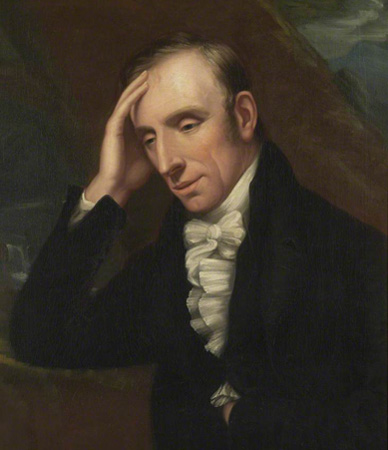
Wordsworth, from “Poems on the Naming of Places

It was an April Morning: fresh and clear
The Rivulet, delighting in its strength,
Ran with a young man’s speed, and yet the voice
Of waters which the winter had supplied
Was softened down into a vernal tone,
The spirit of enjoyment and desire,
And hopes and wishes, from all living things
Went circling, like a multitude of sounds.
The budding groves appeared as if in haste
To spur the steps of June; as if their shades
Of various green were hindrances that stood
Between them and their object: yet, meanwhile,
There was such deep contentment in the air
That every naked ash, and tardy tree
Yet leafless, seemed as though the countenance
With which it looked on this delightful day
Were native to the summer. – Up the brook
I roamed in the confusion of my heart,
Alive to all things and forgetting all.
At length I to a sudden turning came
In this continuous glen, where down a rock
The stream, so ardent in its course before,
Sent forth such sallies of glad sound, that all
Which I till then had heard, appeared the voice
Of common pleasure: beast and bird, the lamb,
The Shepherd’s dog, the linnet and the thrush
Vied with this waterfall, and made a song
Which, while I listened, seemed like the wild growth
Or like some natural produce of the air
That could not cease to be. Green leaves were here,
But ’twas the foliage of the rocks, the birch,
The yew, the holly, and the bright green thorn,
With hanging islands of resplendent furze:
And on a summit, distant a short space,
By any who should look beyond the dell,
A single mountain Cottage might be seen.
I gazed and gazed, and to myself
I said, ‘Our thoughts at least are ours; and this wild nook,
My EMMA, I will dedicate to thee.
– Soon did the spot become my other home,
My dwelling, and my out-of-doors abode.
And, of the Shepherds who have seen me there,
To whom I sometimes in our idle talk
Have told this fancy, two or three, perhaps,
Years after we are gone and in our graves,
When they have cause to speak of this wild place,
May call it by the name of EMMA’S DELL.

Discover more from Tim Miller

Subscribe to get the latest posts to your email.

#225 – The invention of the wheel, and the power of storytelling Human Voices Wake Us

An episode from 4/13/26: Tonight, I read about the invention of the wheel and what it meant for the earliest communities of Europe and the Eurasian steppes, from David Anthony’s The Horse, the Wheel, and Language.After this, a few passages from Norman Longmate’s How We Lived Then: A History of Everyday Life During the Second World War tells the story of gasoline rationing in England during the war, and the sometimes-comical lengths people went to hoard the fuel they could get a hold of.Finally, passages from S. Y. Agnon’s Days of Awe: A Treasury of Jewish Wisdom for Reflection, Repentance, and Renewal on the High Holy Days and Gershom Scholem’s Major Trends in Jewish Mysticism illustrate the power of language and storytelling in the Jewish tradition.The best way to support the podcast is by leaving a review on Apple or Spotify, sharing it with others, or sending me a note on what you think. You can also order any of my books: Time and the River: From Columbine to the Invention of Fire, Notes from the Grid, To the House of the Sun, The Lonely Young & the Lonely Old, and Bone Antler Stone. I've also edited a handful of books in the S4N Pocket Poems series. I also have a YouTube channel where I share poems and excerpts from these books, mostly as YouTube shorts.Email me at humanvoiceswakeus1@gmail.com.
  1. #225 – The invention of the wheel, and the power of storytelling
  2. #224: Let's talk about William Blake
  3. #223 – How to write two novels at the same time, with Charles Dickens
  4. #222: Seamus Heaney – 10 Essential Poems
  5. #221: Volcanoes, Plagues & the Childhood of a Kabbalist
  6. #220: The working poor and a so-so murder show
  7. #219: When a paragraph changes your life
  8. #218: Poetry to Live By
  9. #217: Voices from 1900-1914
  10. #216: Poets, Prophets, Seeresses & Goddesses from Time & the River

Discover more from Tim Miller

Subscribe now to keep reading and get access to the full archive.

Continue reading