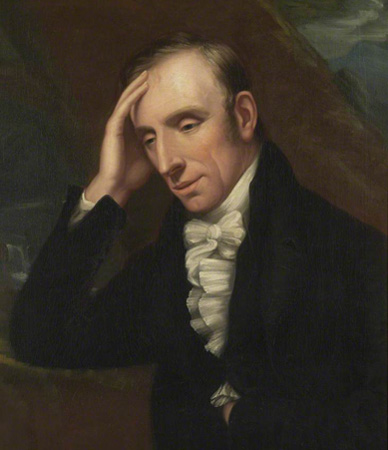
Wordsworth, from “Poems on the Naming of Places
It was an April Morning: fresh and clear
The Rivulet, delighting in its strength,
Ran with a young man’s speed, and yet the voice
Of waters which the winter had supplied
Was softened down into a vernal tone,
The spirit of enjoyment and desire,
And hopes and wishes, from all living things
Went circling, like a multitude of sounds.
The budding groves appeared as if in haste
To spur the steps of June; as if their shades
Of various green were hindrances that stood
Between them and their object: yet, meanwhile,
There was such deep contentment in the air
That every naked ash, and tardy tree
Yet leafless, seemed as though the countenance
With which it looked on this delightful day
Were native to the summer. – Up the brook
I roamed in the confusion of my heart,
Alive to all things and forgetting all.
At length I to a sudden turning came
In this continuous glen, where down a rock
The stream, so ardent in its course before,
Sent forth such sallies of glad sound, that all
Which I till then had heard, appeared the voice
Of common pleasure: beast and bird, the lamb,
The Shepherd’s dog, the linnet and the thrush
Vied with this waterfall, and made a song
Which, while I listened, seemed like the wild growth
Or like some natural produce of the air
That could not cease to be. Green leaves were here,
But ’twas the foliage of the rocks, the birch,
The yew, the holly, and the bright green thorn,
With hanging islands of resplendent furze:
And on a summit, distant a short space,
By any who should look beyond the dell,
A single mountain Cottage might be seen.
I gazed and gazed, and to myself
I said, ‘Our thoughts at least are ours; and this wild nook,
My EMMA, I will dedicate to thee.
– Soon did the spot become my other home,
My dwelling, and my out-of-doors abode.
And, of the Shepherds who have seen me there,
To whom I sometimes in our idle talk
Have told this fancy, two or three, perhaps,
Years after we are gone and in our graves,
When they have cause to speak of this wild place,
May call it by the name of EMMA’S DELL.