from John Richardson’s biography of Picasso:

When questioned much later about his earliest sexual experience, Picasso claimed that his sex life had started very early on: “Yes,” he says smiling, with a sparkle in his eye, “I was still quite small”—and he indicated a diminutive height wit his hand. “Obviously I didn’t wait for the age of reason. If I had I might not have begun at all!” He was not exaggerating. Given his precocity, Picasso’s sexual initiation might have occurred in Corunna, but more likely in one of the whorehouses in the Barri Xino, Barcelona’s labyrinthine red-light district, whose amenities rivaled Marseille’s vieux port. Where the boy found the cash for prostitutes is a mystery. His pocket money would not have sufficed. Did older friends like Pallarès treat him to the occasional girl, or were his boyish charms such that the motherly whores did not charge him? All those loving older women must have brought back his childhood in Málaga.

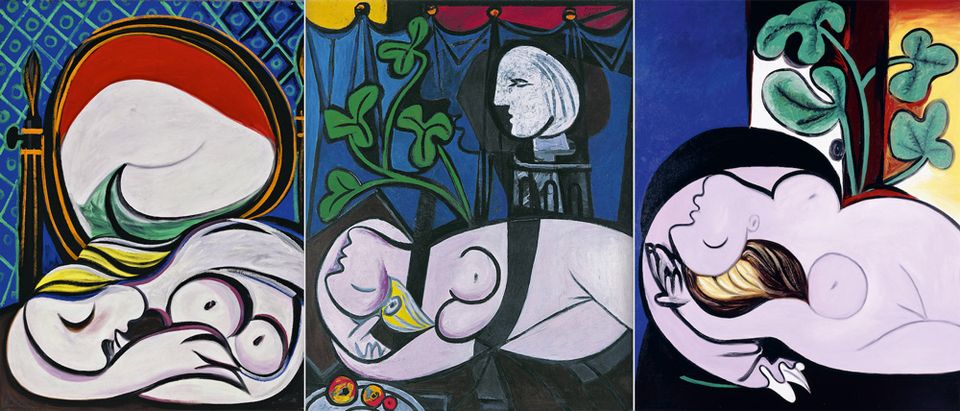
These early experiences in the brothels of Barcelona seem to have reinforced Picasso’s Andalusian misogyny. The fact that he would often treat his mistresses as whores tends to bear this out. So does the work, not least Les Demoiselles d’Avignon, a group of whores whom he chose to identify as his women friends. Thirty years later, in image after image, the misogynistic pasha would endlessly reduce his teenage mistress, Marie-Thérèse Walter, to a thing of flesh and orifices in works of orgasmic explosiveness. Again at the end of his life, when the sexual act and creative act become metaphors for each other, the work gapes with vaginas, which the artist’s loaded brush—his surrogate penis—would remorselessly probe. And where does the aged Picasso go back to in imagination but the Barri Xino, which he evokes again and again in prints and drawings that depict the artist’s studio in terms of a brothel, a circus, or a mixture of all three?

        – John Richardson, A Life of Picasso: The Prodigy, 1881-1906, 67-8

Discover more from Tim Miller

Subscribe to get the latest posts to your email.

#225 – The invention of the wheel, and the power of storytelling Human Voices Wake Us

An episode from 4/13/26: Tonight, I read about the invention of the wheel and what it meant for the earliest communities of Europe and the Eurasian steppes, from David Anthony’s The Horse, the Wheel, and Language.After this, a few passages from Norman Longmate’s How We Lived Then: A History of Everyday Life During the Second World War tells the story of gasoline rationing in England during the war, and the sometimes-comical lengths people went to hoard the fuel they could get a hold of.Finally, passages from S. Y. Agnon’s Days of Awe: A Treasury of Jewish Wisdom for Reflection, Repentance, and Renewal on the High Holy Days and Gershom Scholem’s Major Trends in Jewish Mysticism illustrate the power of language and storytelling in the Jewish tradition.The best way to support the podcast is by leaving a review on Apple or Spotify, sharing it with others, or sending me a note on what you think. You can also order any of my books: Time and the River: From Columbine to the Invention of Fire, Notes from the Grid, To the House of the Sun, The Lonely Young & the Lonely Old, and Bone Antler Stone. I've also edited a handful of books in the S4N Pocket Poems series. I also have a YouTube channel where I share poems and excerpts from these books, mostly as YouTube shorts.Email me at humanvoiceswakeus1@gmail.com.
  1. #225 – The invention of the wheel, and the power of storytelling
  2. #224: Let's talk about William Blake
  3. #223 – How to write two novels at the same time, with Charles Dickens
  4. #222: Seamus Heaney – 10 Essential Poems
  5. #221: Volcanoes, Plagues & the Childhood of a Kabbalist
  6. #220: The working poor and a so-so murder show
  7. #219: When a paragraph changes your life
  8. #218: Poetry to Live By
  9. #217: Voices from 1900-1914
  10. #216: Poets, Prophets, Seeresses & Goddesses from Time & the River

Discover more from Tim Miller

Subscribe now to keep reading and get access to the full archive.

Continue reading