from John Richardson’s biography of Picasso:
When questioned much later about his earliest sexual experience, Picasso claimed that his sex life had started very early on: “Yes,” he says smiling, with a sparkle in his eye, “I was still quite small”—and he indicated a diminutive height wit his hand. “Obviously I didn’t wait for the age of reason. If I had I might not have begun at all!” He was not exaggerating. Given his precocity, Picasso’s sexual initiation might have occurred in Corunna, but more likely in one of the whorehouses in the Barri Xino, Barcelona’s labyrinthine red-light district, whose amenities rivaled Marseille’s vieux port. Where the boy found the cash for prostitutes is a mystery. His pocket money would not have sufficed. Did older friends like Pallarès treat him to the occasional girl, or were his boyish charms such that the motherly whores did not charge him? All those loving older women must have brought back his childhood in Málaga.
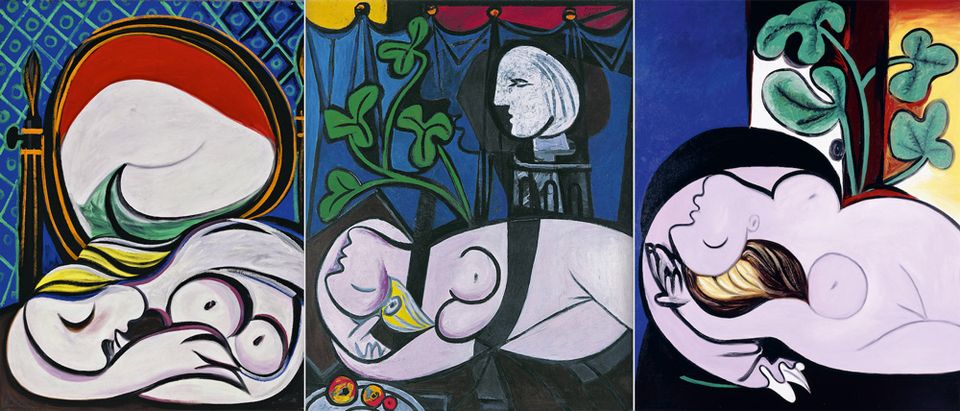
These early experiences in the brothels of Barcelona seem to have reinforced Picasso’s Andalusian misogyny. The fact that he would often treat his mistresses as whores tends to bear this out. So does the work, not least Les Demoiselles d’Avignon, a group of whores whom he chose to identify as his women friends. Thirty years later, in image after image, the misogynistic pasha would endlessly reduce his teenage mistress, Marie-Thérèse Walter, to a thing of flesh and orifices in works of orgasmic explosiveness. Again at the end of his life, when the sexual act and creative act become metaphors for each other, the work gapes with vaginas, which the artist’s loaded brush—his surrogate penis—would remorselessly probe. And where does the aged Picasso go back to in imagination but the Barri Xino, which he evokes again and again in prints and drawings that depict the artist’s studio in terms of a brothel, a circus, or a mixture of all three?
– John Richardson, A Life of Picasso: The Prodigy, 1881-1906, 67-8