Read the other Great Myths here
The Prose Edda, one of the greatest sources for Norse mythology, begins with the following simple frame story: a king named Gylfi is tricked out of a good deal of his land, and he goes to the home of the gods to question them. His questions, and the answers he receives, constitute a telling of Norse myth from creation to the end of the world:
King Gylfi was ruler in what is now called Sweden. Of him it is said that he gave a certain vagrant woman, as a reward for his entertainment, one plough-land in his kingdom, as much as four oxen could plough up in a day and a night. Now this woman was one of the race of the Æsir. Her name was Gefiun. She took four oxen from the north, from Giantland, the sons of her and a certain giant, and put them before the plough. But the plough cut so hard and deep that it uprooted the land, and the oxen drew the land out into the sea to the west and halted in a certain sound. There Gefiun put the land and gave it a name and called it Zealand. Where the land had been lifted from there remained a lake; this is now called Lake Mälar in Sweden. And the inlets in the lake correspond to the headlands in Zealand. Thus said the poet Bragi the Old:
Gefiun drew from Gylfi, glad, a deep-ring of land [the island of Zealand] so that from the swift-pullers [oxen] steam rose: Denmark’s extension. The oxen wore eight brow-stars [eyes] as they went hauling their plunder, the wide island of meadows, and four heads.
King Gylfi was clever and skilled in magic. He was quite amazed that the Æsir-people had the ability to make everything go in accordance with their will. He wondered whether this could be as a result of their own nature, or whether the divine powers they worshipped could be responsible. He set out to Asgard and travelled in secret and assumed the form of an old man and so disguised himself. But the Æsir were the wiser in that they had the gift of prophecy, and they saw his movements before he arrived, and prepared deceptive appearances for him. When he got into the city he saw there a high hall, so that he could scarcely see over it. Its roof was covered with gilded shields like tiles. Thiodolf of Hvinir refers thus to Val-hall being roofed with shields:
On their backs they shine—they were bombarded with stones—Svafnir’s [Odin’s] hall-shingles [shields], those sensible men.
In the doorway of the hall Gylfi saw a man juggling with knives, keeping seven in the air at a time. This man spoke first and asked him his name. He said it was Gangleri and that he had travelled trackless ways; he requested that he might have a night’s lodging there and asked whose hall it was. The man replied that it belonged to their king.
“And I can take you to see him. Then you can ask him his name yourself.”
And the man turned ahead of him into the hall. Gylfi followed and the door immediately shut on his heels. He saw there many apartments and many people, some engaged in games, some were drinking, some where armed and were fighting. He looked around and thought many of the things he saw were incredible. Then he said:
“Every doorway, before you go through, should be peered round, for you cannot know for certain where enemies may be sitting waiting inside.”
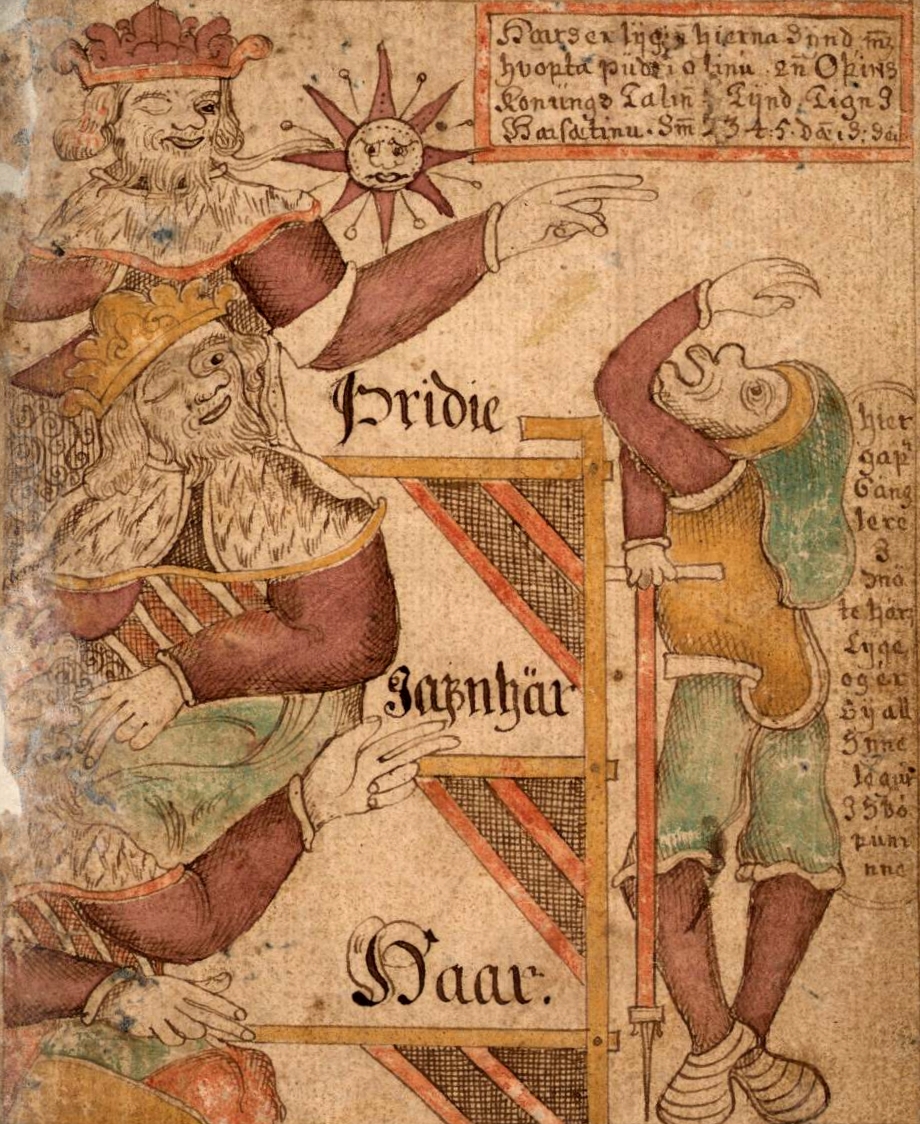
He saw three thrones one above the other, and there were three men, one sitting in each. Then he asked what the name of their ruler was. The man who had brought him in replied that the one that sat in the lowest throne was king and was called High, next to him the one called Just-as-high, and the one sitting at the top was called Third. Then High asked the newcomer whether he had any further business, though he was welcome to food and drink like everyone else there in the High one’s all. He said that he wished first to find out if there was any learned person in there. High said he would not get out unscathed unless he was more learned, and
“Stand out in front while you ask: he who tells shall sit.”
Gangleri began his questioning thus….
– from the “Gylfaginning” in the Prose Edda, translated by Anthony Faulkes, Edda, 7-8