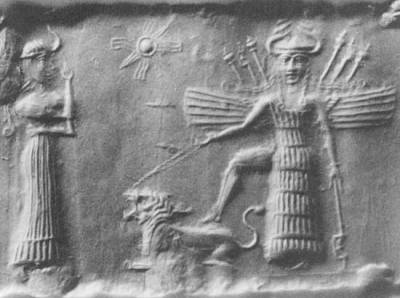
inanna

Read the other Great Myths Here

Just before his death, Gilgamesh’s friend Enkidu dreams of the Underworld. While what remains of the story is fragmentary, it is remarkable in part for being one of the earliest descriptions in literature of an Underworld. In this case, it is less a place of punishment than one of eternal boredom and gathering dust. It likely influenced later Greek conceptions of the Underworld, best exemplified by Achilles statement that he would rather be a poor farmer on earth than “king over all the perished dead.”

[He struck me and] turned me into a dove.

[He bound] my arms like the wings of a bird,
to lead me captive to the house of darkness, seat of Irkalla:
to the house which none who enters ever leaves,
on the path that allows no journey back,

to the house whose residents are deprived of light,
where soil is itself their sustenance and clay their food,
where they are clad like birds in coats of feathers,
and see no light, but dwell in darkness.

On door [and bolt the dust lay thick,]
on the House [of Dust was poured a deathly quiet.]
In the House of Dust that I entered,

I looked around me, saw “crowns” in a throng,
there were the crowned [heads] who’d ruled the land since days of yore,
who’d served the roast [at the] tables of Anu and Enlil,
who’d proffered baked bread, and poured them cool water from skins.

In the House of Dust that I entered,
there were the en-priests and lagar-priests,
there were the lustration-priests and the lumahhu-priests,
there were the great gods’ gudapsû-priests,

there was Etana, there was Shakkan,
[there was] the queen of the Netherworld, the goddess Ereshkigal.
Before her sat [Belet]-ṣeri, the scribe of the Netherworld,
holding [a tablet], reading aloud in her presence.

[She raised] her head and she saw me:
“[Who was] it fetched this man here?
[Who was it] brought here [this fellow?]”

(The rest of the story is lost.)

– The Epic of Gilgamesh, tablet VII, tr. Andrew George


Discover more from Tim Miller

Subscribe to get the latest posts to your email.

#223 – How to write two novels at the same time, with Charles Dickens Human Voices Wake Us

An episode from 1/10/23: Tonight we take a peek into the creative life of Charles Dickens (1812-1870). Through a handful of readings from Claire Tomalin’s biography of Dickens, we see how he was able to juggle, for almost a year, the writing of two novels for simultaneous serial publication. Then, thanks to a letter written by Fyodor Dostoevsky, who visited Dickens in London in 1862, we also hear Dickens admitting that his villains were better reflections of himself than his more lovable and generous characters. We also answer the question: what do David Copperfield and Jane Eyre have in common? Finally, we hear about the chance encounter Dickens had with a young fan in America, who grew up to become a novelist herself.Note: these readings from the life of Dickens were originally the first part of a longer episode, hence the brief mention of the second part, no longer included, and the abrupt ending here. Listeners will forgive these frayed edges. The best way to support the podcast is by leaving a review on Apple or Spotify, sharing it with others, or sending me a note on what you think. You can also order any of my books: Time and the River: From Columbine to the Invention of Fire, Notes from the Grid, To the House of the Sun, The Lonely Young & the Lonely Old, and Bone Antler Stone. I've also edited a handful of books in the S4N Pocket Poems series. I also have a YouTube channel where I share poems and excerpts from these books, mostly as YouTube shorts. Email me at humanvoiceswakeus1@gmail.com.
  1. #223 – How to write two novels at the same time, with Charles Dickens
  2. #222: Seamus Heaney – 10 Essential Poems
  3. #221: Volcanoes, Plagues & the Childhood of a Kabbalist
  4. #220: The working poor and a so-so murder show
  5. #219: When a paragraph changes your life
  6. #218: Poetry to Live By
  7. #217: Voices from 1900-1914
  8. #216: Poets, Prophets, Seeresses & Goddesses from Time & the River
  9. #215: 8 Favorite Poems from "Time and the River"
  10. #214: Two of the Best Poems You've Never Heard of (by William Cullen Bryant)

Discover more from Tim Miller

Subscribe now to keep reading and get access to the full archive.

Continue reading