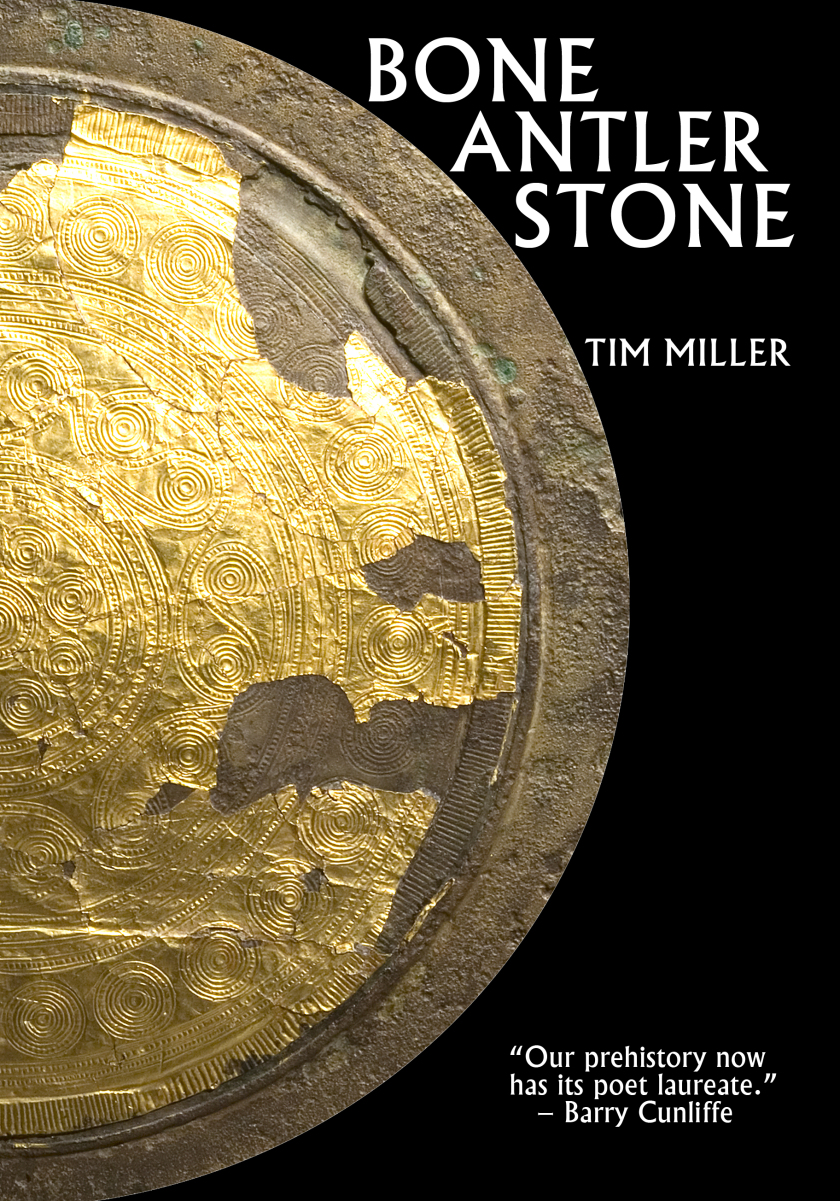
bone antler stoneMany thanks to Tom Zimmerman at The Big Windows Review for his review of Bone Antler Stone. I’ve pasted an excerpt below, and you can read the entire review here. Excerpts and reviews from the book are here.

“… [Bone Antler Stone] is an act of powerful sympathetic imagination that forges a connection between lost cultures and our own and that reminds us of our commonality as a species…. The poems themselves are mostly short, unrhymed, and as sturdily built as their subject matter. The tone is reverent and full of awe for the people, their artifacts, and the landscape itself…. throughout the book, there is a marked awareness of art’s magic, strangeness, and immortality. Many of the people in the poems live (and die) as outsider artists within their cultures: the “hobble-headed,” lame-footed smith in “Song to the Smith”; “The Seeress of Vix,” with her “crooked look” and “knobbled walk”; and, among the “Bog Bodies,” the Haraldskaer Woman (“They didn’t dare to cut my hair / and I was thrown in alive under their envy”), the Kayhausen Boy (“But my bog dreams amid all that dead matter / were to me a song I will never leave”), and the Grauballe Man (“perhaps special, perhaps a source of shame / perhaps feared and gifted in my defect”), to name a few. Fittingly, in the book’s final poem, “The Wanderer II (Flight from Orkney),” the poet, using Pytheas as his mouthpiece, envisions his own work as a continuation of art’s regenerative power.”

Discover more from Tim Miller

Subscribe to get the latest posts to your email.

Bone Antler Stone: Poems

#230 – The mythology of the bear, and Byron gets apocalyptic Human Voices Wake Us

An episode from 5/18/26: Tonight I read about the bear in folklore and mythology from two books everybody should have on their shelves: the Taschen Book of Symbols and the Penguin Dictionary of Symbols. Browsing through either puts you in contact with our best stories and, with the Taschen book, some of our best artwork.Next, I read Lord Byron’s (1788-1824) apocalyptic poem Darkness from 1816. You can read more about the volcanic eruption that inspired poem, and produced the “year without summer,” here.Finally, I read a few passages on revelation and the religious experience from the rabbi, theologian and civil rights activist Abraham Joshua Heshel’s (1907-1962) God in Search of Man: A Philosophy of Judaism.The best way to support the podcast is by leaving a review on Apple or Spotify, sharing it with others, or sending me a note on what you think. You can also order any of my books: Time and the River: From Columbine to the Invention of Fire, Notes from the Grid, To the House of the Sun, The Lonely Young & the Lonely Old, and Bone Antler Stone. I've also edited a handful of books in the S4N Pocket Poems series. I also have a YouTube channel where I share poems and excerpts from these books, mostly as YouTube shorts.Email me at humanvoiceswakeus1@gmail.com.
  1. #230 – The mythology of the bear, and Byron gets apocalyptic
  2. #229 : Mother Earth and myths of mining and agriculture
  3. #228 – What Ted Bundy did on July 14, 1974
  4. #227 – The Great Fire of London and the destruction of Jerusalem
  5. #226: The Vitality and terror of cities
  6. #225 – The invention of the wheel, and the power of storytelling
  7. #224: Let's talk about William Blake
  8. #223 – How to write two novels at the same time, with Charles Dickens
  9. #222: Seamus Heaney – 10 Essential Poems
  10. #221: Volcanoes, Plagues & the Childhood of a Kabbalist

Discover more from Tim Miller

Subscribe now to keep reading and get access to the full archive.

Continue reading