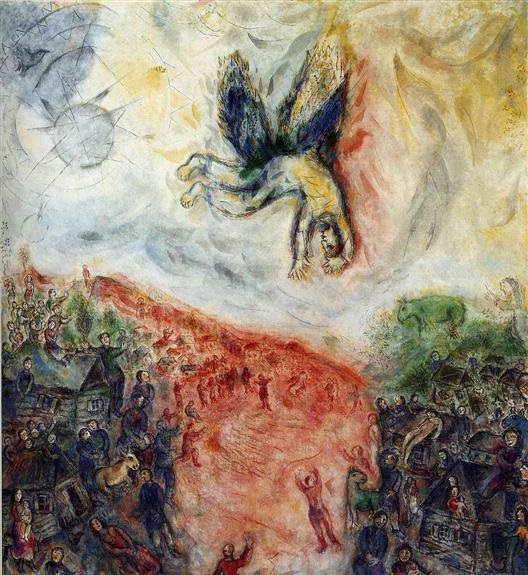
But Daedalus was weary; by this time,
he’d been exiled in Crete too long; he pined
for his own land; but he was blocked – the sea
stood in his way. “Though Minos bars escape
by land or waves,” he said, “I still can take
the sky – there lies my path. Though he owns all,
he does not own the air!” At once he starts
to work on unknown arts, to alter nature.
He lays out feathers – all in order, first
the shorter, then the longer (you’d have said
they’d grown along a slope); just like the kind
of pipes that country people used to fashion,
where from unequal reed to reed the rise
is gradual. And these he held together
with twine around the center; at the base
he fastened them with wax; and thus arranged –
he’d bent them slightly – they could imitate
the wings of true birds.
As he worked at this,
his young son, Icarus, inquisitive,
stood by and – unaware that what he did
involved a thing that would imperil him –
delighted, grabbed the feathers that the wind
tossed, fluttering, about; or he would ply
the blond wax with his thumb; and as he played,
the boy disturbed his father’s wonder-work.
When Daedalus had given the last touch,
the craftsman thought he’d try two wings himself;
so balanced, as he beat the wings, he hung
poised in the air. And then to his dear son,
he gave another pair. “O Icarus,”
he said, “I warn you: fly a middle course.
If you’re too low, sea spray may damp your wings;
and if you fly too high, the heat is scorching.
Keep to the middle then. And keep your eyes
on me and not on Helice, Bootes,
or on Orion’s unsheathed sword. Where I
shall lead – that’s where you fly: I’ll be your guide.”
And as he taught his son the rules of flight,
He fitted to the shoulders of the boy
those wings that none had ever seen before.
The old man worked and warmed; his cheeks grew damp
with tears; and with a father’s fears, his hands
began to tremble. Then he kissed his son
(he never would embrace the boy again);
and poised upon his wings, he flew ahead,
still anxious for the follower he led
(much like the bird who, from her nest on high
leads out her tender fledglings to the sky).
He urges on his son, saying he must
keep up, not fall behind; so he instructs
the boy in flight, an art most dangerous;
and while the father beats his wings, he turns
to watch his son, to see what he has done.
A fisherman, who with his pliant rod
was angling there below, caught sight of them;
and then a shepherd leaning on his staff
and, too, a peasant leaning on his plow
saw them and were dismayed: they thought that these
must surely be some gods, sky-voyaging.
Now on their left they had already passed
the isle of Samos – Juno’s favorite –
Delos and Paros, and Calymne, rich
in honey, and Labinthos, on the right.
The boy had now begun to take delight
in his audacity; he left his guide
and, fascinated by the open sky,
flew higher; and the scorching sun was close;
the fragrant wax that bound his wings grew soft,
then melted. As he beats upon the air,
his arms can get no grip; they’re wingless – bare.
The father – though the word is hollow now –
cried: “Icarus! Where are you?” And that cry
echoed again, again till he caught sight
of feathers on the surface of the sea.
And Daedalus cursed his own artistry,
then built a tomb to house his dear son’s body.
There, where the boy was buried, now his name
remains: that island is Icaria.
– Ovid, Metamorphoses,
Book 8, translated by Allen Mandelbaum
When Daedalus – for so the tale is told –
fled Minos’ kingdom on swift wings and dared
to trust his body to the sky, be floated
along strange ways, up toward the frozen North,
until he gently came to rest upon
the mountaintop of Chalcis. Here he was
returned to earth, and here he dedicated
his oar-like wings to you, Apollo; here
he built a splendid temple in your honor.
Upon the gates he carved Androgeos’ death,
and then the men of Athens, made to pay
each year with seven bodies of their sons;
before them stands the urn, the lots are drawn.
And facing this, he set another scene:
the land of Crete, rising out of the sea;
the inhuman longing of Pasiphaë,
the lust that made her mate the bull by craft;
her mongrel son, the two-formed Minotaur,
a monument to her polluted passion.
And here the inextricable labyrinth,
the house of toil was carved, but Daedalus
took pity on the princess Ariadne’s
deep love, and he himself helped disentangle
the wiles and mazes of the palace, with
a thread he guided Theseus’ blinded footsteps.
And Icarus, you also would have played
great part in such work, had his grief allowed;
twice he had tried to carve your trials in gold,
and twice a father’s hand had failed.
– Virgil, The Aeneid,
Book 6, translated by Allen Mandelbaum


