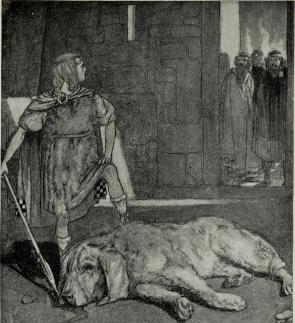
 When Culand the smith offered Conchubur his hospitality, he said that a large host should not come, for the feast would be the fruit not of lands and possessions but of his tongs and his two hands. Conchubur went with fifty of his oldest and most illustrious heroes in their chariots. First, however, he visited the playing field, for it was his custom when leaving or returning to seek the boys’ blessing; and he saw Cú Chulaind driving the ball past the three fifties of boys and defeating them. When they drove at the hole, Cú Chulaind filed the hole with his balls, and the boys could not stop them; when the boys drove at the hole, he defended it alone, and not a single ball went in. When they wrestled, he overthrew the three fifties of boys by himself, but all of them together could not overthrow him. When they played at mutual stripping, he stripped them all so that they were stark naked, while they could not take so much as the brooch from his mantle.
Conchubur thought all this wonderful. He asked if the boy’s deeds would be similarly distinguished when he became a man, and everyone said that they would be. He said to Cú Chulaind, then, “Come with me to the feast, and you will be a guest.” “I have not had my fill of play yet,” replied the boy. “I will come after you.”
When everyone had arrived at the feast, Culand said to Conchubur, “Do you expect anyone else?” “I do not,” answered Conchubur, forgetting that his fosterling was yet to come. “I have a watchdog,” said Culand, “with three chains on him and three men on every chain. I will loose him now to guard our cattle and our herds, and I will close the courtyard.”
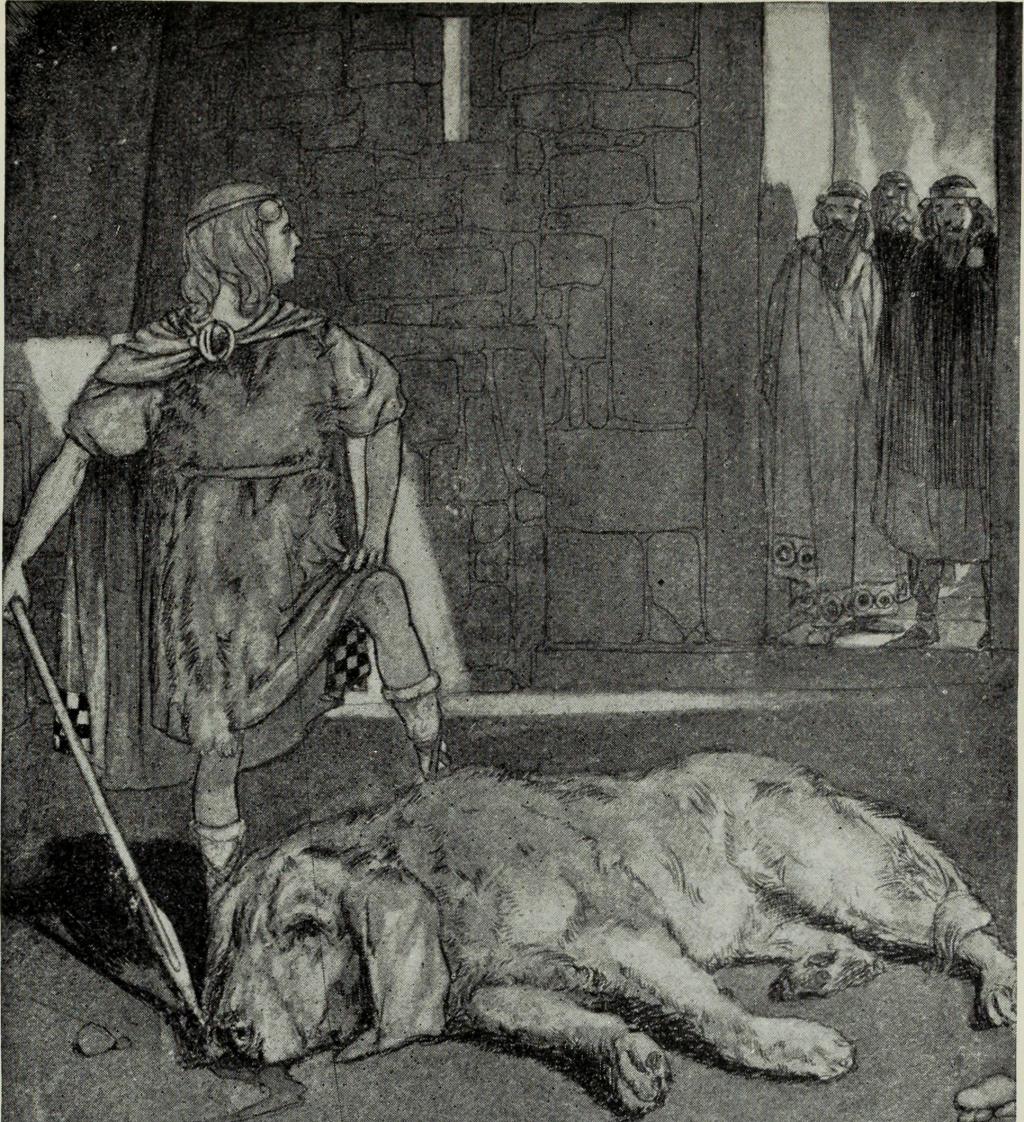
By that time, the boy was on his way to the feast, and when the hound attacked him he was still at play. He would throw his ball up and his hurley after it, so that the hurley struck the ball and so that each stroke was the same; he would also throw his javelin on ahead and catch it before it could strike the ground. The hound’s attack did not distract the boy from his play; Conchubur and his people, however, were so confounded they could not move. They could not believe that, when the courtyard doors were opened, they would find the boy alive. But, when the hound attacked him, the boy threw away his ball and hurley and went at it with his bare hands: he put one hand on the hound’s throat and the other on its back and struck it against a pillar until every limb fell apart.
The Ulaid rose to rescue him, some to the courtyard and some to the door of the courtyard, and they took him in to Conchubur. Everyone was greatly alarmed that the son of the king’s sister had nearly been killed. But Culand entered the house and said “Welcome, lad, for the sake of your mother’s heart. As for myself, however, this was an evil feast. My life is lost, and my household are out on the plain, without our hound. It secured life and honour; it protected our goods and cattle and every creature between field and house. It was the man of the family.” “No great matter that,” replied the boy. “I will rear for you a whelp from the same litter, and, until it is grown and capable of action, I will be the hound that protects your cattle and yourself. I will protect all Mag Muirthemni, and neither herd nor flock will be taken without my knowledge.” “Cú Chulaind will be your name henceforth,” said Cathub. “I prefer my own name,” said Cú Chulaind.
The boy who did that when he was six would not surprise by doing heroic deeds when he was seventeen.


4 responses