 The Indian legend of the “Face of Glory” begins, like that of the Man-Lion, with the case of an infinitely ambitious king who through extraordinary austerities had gained the power to unseat the gods and was now sole sovereign of the universe. His name was Jalandhara, “Water Carrier,” and he conceived the impudent notion of challenging even Shiva, the supreme sustainer of the world. (In the Man-Lion legend this was the role of Vishnu. The present legend belongs to the mythology of Shiva.) The king’s idea was to demand that Shiva should surrender to him the goddess Parvati, his wife, and to this end he sent as messenger a terrible monster called Rahu, “the Seizer,” whose usual role is to seize and eclipse the moon.
Rahu approached the Lord of Life and Death, and when he had stated Jalandhara’s demand, the god simply widened that third eye between his brows, whereupon a flash of lightning shot forth, striking the earth and taking the form of a lion-headed demon whose alarming body, lean, huge, and emaciated, gave notice of insatiable hunger. Its throat roared like thunder; its two eyes burned like fire; the mane, disheveled, floated far and wide into space. Clearly its strength was irresistible. Rahu was aghast and did the only thing left for him to do. He threw himself on Shiva’s mercy, and the god—for such is the way of gods—granted protection.
This, however, only created a new predicament, since the ravenous half-lion, who was nothing if not hunger incarnate, now had nothing to eat. And he, too, turned to the god, imploring him to furnish a victim. Whereupon Shiva, with one of those inspirations such as occur only to the greatest, suggested that the monster should eat himself—to which work the prodigy immediately turned and the gorgeous banquet began.
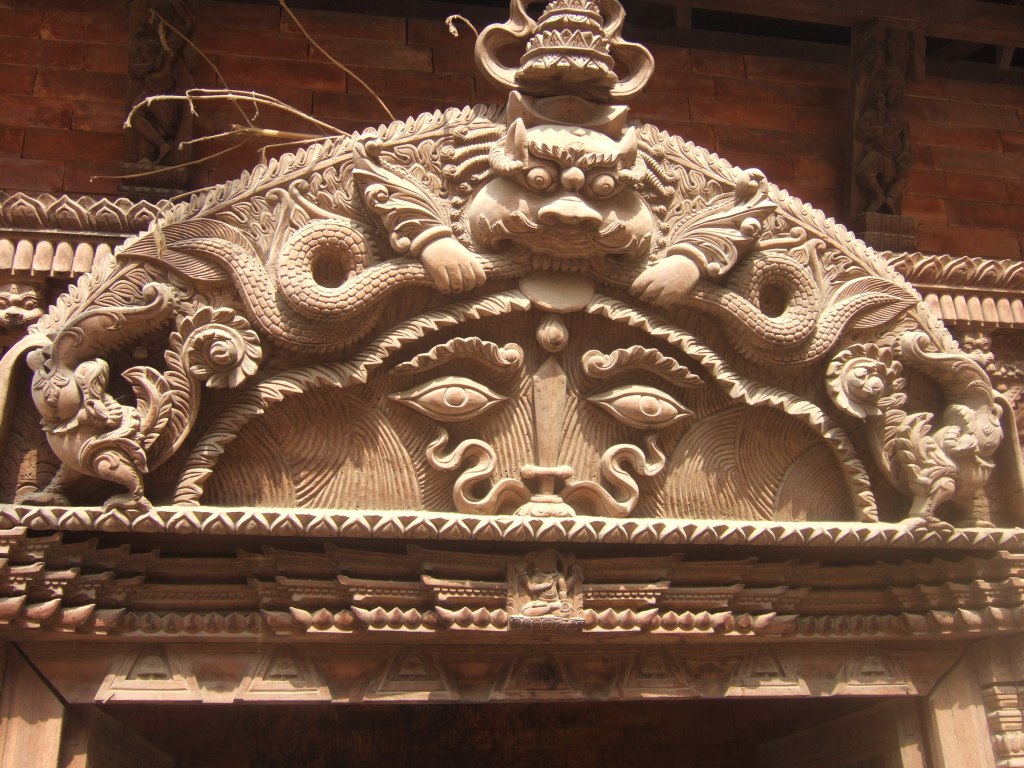
Commencing with his feet and hands, continuing through his legs and arms, the monster, ravenous and unable to stop, let his teeth go right on chopping through his belly, chest, and even his neck, until there was nothing left by a face. And the god, who had been watching with delight this epitomization of the self-consuming mystery that is life, smiled, when the feat had been accomplished, upon what remained of that creature of his wrath, and said to it: “You shall be known henceforth as Kirttimukha, ‘Face of Glory,’ and shall abide forever at my door. No one who fails to worship you will ever obtain my grace.”
– retold by Joseph Campbell in The Mythic Image, 218; originally in the Skanda Purana


One response