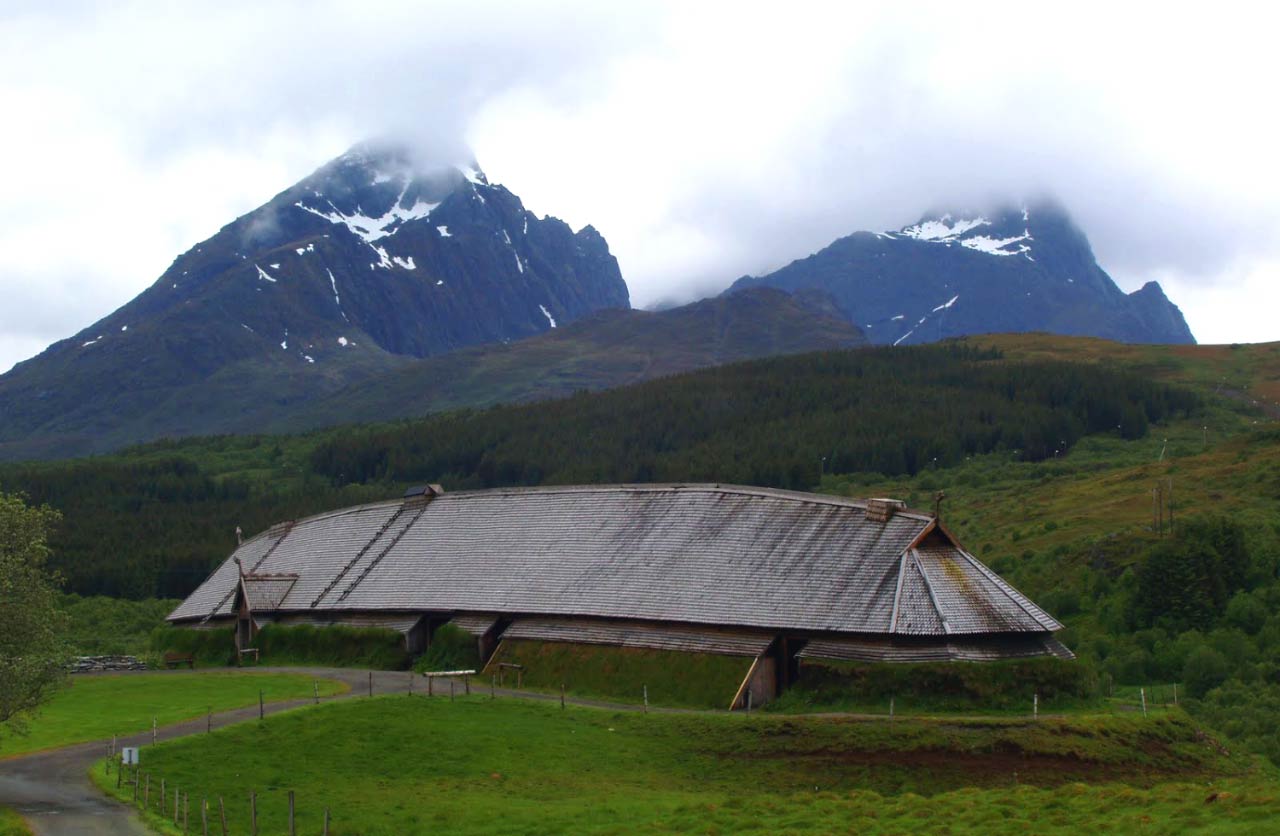
Then from the moor under misty hillsides,
Grendel came gliding girt with God’s anger.
The man-scather sought someone to snatch
from the high hall. He crept under clouds
until the caught sight of the king’s court
whose gilded gables he knew at a glance.
He often had haunted Hrothgar’s house;
but he never found, before or after,
hardier hall-thanes or harder luck.
The joyless giant drew near the door,
which swiftly swung back at the touch of his hand
though bound and fastened with forge-bent bars.
The building’s mouth had been broken open,
and Grendel entered with ill intent.
Swollen with fury, he stalked over flagstones
and looked round the manse where many men lay.
An unlovely light most like a flame
flashed from his eyes, flared through the hall
at young soldiers dozing shoulder to shoulder,
comradely kindred. The cruel creature laughed
in his murderous mind, thinking how many
now living would die before the day dawned,
how glutted with gore he would guzzle his fill.
It was not his fate to finish the feast
he foresaw that night.
Soon the Stalwart,
Hygelac’s kinsman, beheld how the horror,
not one to be idle, went about evil.
For his first feat he suddenly seized
a sleeping soldier, slashed at the flesh,
bit through bones and lapped up the blood
that gushed from veins as he gorged on gobbets.
Swiftly he swallowed those lifeless limbs,
hands and feet whole; then he headed forward
with open palm to plunder the prone.
One man [Beowulf] angled up on his elbow:
the fiend soon found he was facing a foe
whose hand-grip was harder than any other
he ever had met in all middle-earth.
Cravenly cringing, coward at heart,
he longed for a swift escape to his lair,
he bevy of devils. He never had known
from his earliest days such awful anguish.
The captain, recalling his speech to the king,
straightaway stood and hardened his hold.
Fingers fractured. The fiend spun round;
the solder stepped closer. Grendel sought
somehow to slip that grasp and escape,
flee to the fens; but his fingers were caught
in too fierce a grip. His foray had failed;
the harn-wreaker rued his raid on Heorot.
From the hall of the Danes a hellish din
beset every soldier outside the stronghold,
louder than laughter of ale-sodden earls.
A wonder it was the wine-hall withstood
this forceful affray without falling to earth.
That beautiful building was firmly bonded
by iron bands forged with forethought
inside and out. As some have told it,
the struggle swept on and slammed to the floor
many mead-benches massive with gold.
No Scylding elders ever imagined
that any would harm their elk-horned hall,
raze what they had wrought, unless flames arose
to enfold an consume it. Frightful new sounds
burst from the building, unnerved the North-Danes,
each one and all who heard those outcries
outside the walls. Wailing in anguish,
the hellish horror, hateful to God,
sang his dismay, seized by the grip
of a man more mighty than any then living.
That shielder of men meant by no means
to let the death-dealer leave with his life,
a life worthless to anyone elsewhere.
Then the young soldiers swung their old swords
again and again to save their guardian,
their kingly comrade, however they could.
Engaging with Grendel and hoping to hew him
from every side, they scarcely suspected
that blades wielded by worthy warriors
never would cut to the criminal’s quick.
The spell was spun so strongly about him
that the finest iron of any on earth,
that sharpest sword-edge left him unscathed.
Still he was soon to be stripped of his life
and sent on a sore sojourn to Hell.
The strength of his sinews would serve him no more;
no more would he menace mankind with his crimes,
his grudge against God, for the high-hearted kinsman
of King Hygelac had hold of his hand.
Each found the other loathsome in life;
but the murderous man-bane got a great wound
as tendons were torn, shoulder shorn open,
and bone-locks broken. Beowulf gained
glory in war; and Grendel went off
bloody and bent to the boggy hills,
sorrowfully seeking his dreary dwelling.
Surely he sensed his life-span was spent,
his days upon days; but the Danes were grateful:
their wish was fulfilled after fearsome warfare.
Wise and strong-willed, the one from afar
head cleansed Heorot, hall of Hrothgar.
Great among Geats, he was glad of his night-work
ending the evil, his fame-winning feat,
fulfilling his oath to aid the East-Danes,
easing their anguish, healing the horror
they suffered so long, no small distress.
As token of triumph, the troop-leader hung
the shorn-off shoulder and arm by its hand:
the grip of Grendel swung from the gable!
Many a warrior met in the morning
around Hrothgar’s hall, so I have heard.
Folk-leaders fared from near and far
over wide lands to look on the wonder,
the track of the terror, glad he had taken
leave of his life when they looked on footprints
wending away to the mere of monsters.
Weary and weak, defeated in war,
he dripped his blood-trail down to dark water,
tinting the terrible tide where he sank,
spilling his lifeblood to swirl in the surge.
There the doomed one dropped into death
where he long had lurked in his joyless lair,
and Hell received his heathen soul.
– Beowulf, original lines 710-852,
translated by Alan Sullivan and Timothy Murphy,
in their edition, lines 637-759
Also, thanks to Jeff Sypeck for introducing me to this translation. His blog is filled with all things Medieval, and worth losing a few hours in


5 responses