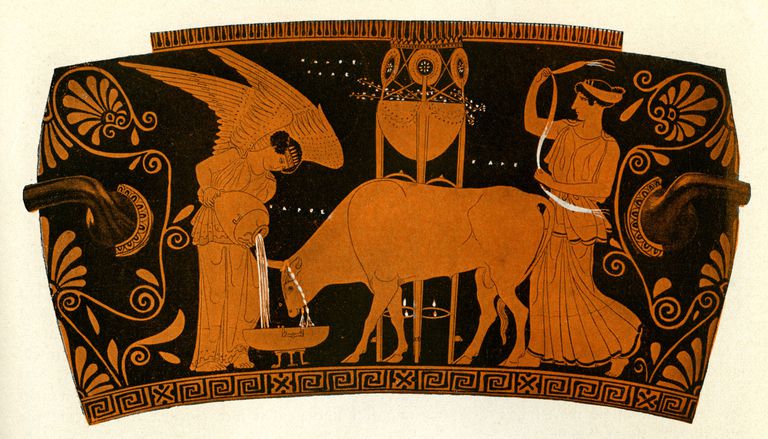
The cow came
in from the field, and the companions of great-hearted Telemachos
came from beside their fast black ship, and the smith came, holding
in his hands the tools for forging bronze, his handicraft’s symbols,
the anvil and the sledgehammer and the well-wrought pincers
with which he used to work the gold, and Athene also
came to be at her rites. Now Nestor, the aged horseman,
gave the smith the gold, and he gilded the cow’s horns with it
carefully, so the god might take pleasure seeing her offering.
Stratios and the noble Echephron led the cow by
the horns, and Aretos came from the inner chamber carrying
lustral water in a flowered bowl, and in the other hand
scattering barley in a basket. Steadfast Thrasymedes
stood by with the sharp ax in hand, to strike down the heifer.
Perseus held the dish for the blood, and the aged horseman
Nestor began with the water and barley, making long prayers
to Athene, in dedication, and threw the head hairs in the fire.
Now when all had may prayer and flung down the scattering barley,
Thrasymedes, the high-hearted son of Nestor, standing
close up, struck, and the ax chopped its way through the tendons
of the neck and unstrung the strength of the cow, and now the daughters
and daughters-in-law of Nestor and his grave wife Eurydike,
eldest of the daughters of Klymenos, raised the outcry.
They lifted the cow from earth of the wide ways, and held her
fast in place, and Peisistratos, leader of men, slaughtered her.
Now when the black blood had run out, and the spirit went from
the bones, they divided her into parts, and cut out the thigh bones
all according to due order, and wrapped them in fat,
making a double fold, and laid shreds of flesh upon them.
The old man burned these on cleft sticks, and poured the gleaming
wine over, while the young men with forks in their hands stood about him.
But when they had burned the thigh pieces and tasted the vitals,
they cut all the remainder into pieces and spitted them,
and roasted all carefully and took off the pieces.
Meanwhile lovely Polykaste, who was the youngest
of the daughters of Nestor, son of Neleus, had bathed Telemachos.
But when she had bathed him and anointed him sleekly with olive oil,
she threw a splendid mantle and a tunic about him,
and he came out from the bath looking like an immortal
and came and sat down beside Nestor, shepherd of the people.
When they had roasted and taken off the spits the outer
meats, they dined where they were sitting, and men of quality
started up and poured them wine in golden goblets.
But when they had put away their desire for eating and drinking,
Nestor the Gerenian horseman began speaking to them:
“Come now, my children, harness the bright-maned horses under
the yoke for Telemachos so that he can get on with his journey.”
– Homer, The Odyssey, Book 2, 430-476,
translated by Richmond Lattimore