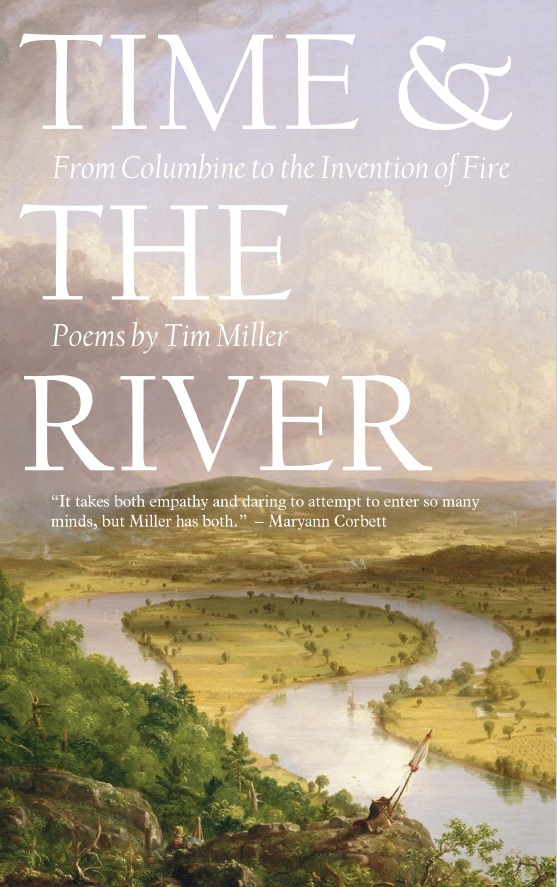
Time & the River: From Columbine to the Invention of Fire
NOW AVAILABLE
What lasts, and what endures? Through more than fifty poems, the first volume of Time and the River takes in war from ancient Nubia to the atomic bomb and Cold War spies, creativity from prehistoric Europe to Emily Dickinson and Albert Einstein, and the sacred from Israelite prophets, the gods and goddesses of old Europe, and Viking-age seers. Painters and writers, ancient Rome and Iron Age burials, Egyptian tombs and high school in America circa 1999 – all find a voice here.
Scroll down for reviews, advance praise, and video/audio readings
Reviews:
Time and the River is a historical poetry collection for the ages… [The book] is comprised of 52 poems, covering various historical guideposts, including Iron Age burials, Israelite prophets, the Cold War, Columbine, Michelangelo and Shakespeare, to name a few.
Taken as a whole, the collection accomplishes what Thomas Wolfe’s main character attempts in a novel sharing a title with Miller’s work: it finds meaning, belonging and direction in the world. The search crosses millennia and epochs, identifying new ways to connect with topics one might more often expect to find in Ph.D. dissertations than poetry collections.
Miller opens the book with “Dylan Klebold’s Crush,” and while many might have trouble identifying with a mass shooter, most readers will have no problem making a connection with a high school girl who was the crush of a boy whose two paths have taken vastly different turns in life. Similarly, in “Merlin,” Miller twists the camera’s focus from Camelot or Guinevere, recycled so often in myth and fantasy, to a man contemplating the passage of time and his body.
Scattered throughout the collection are several poems with Jewish themes. In “Europe, 1941-1945,” Miller writes about the Holocaust, and the writing is as plaintive and filled with emotion as much of the work written in literature that has contemplated the tragedy and human expense of the 6 million murdered. “Ezekiel” takes a personal look at the prophet, who is “broken-hearted at forty-three… I am white-chested at forty-three… I am forty-three and tired of memory.” Thoughts more expected to be spoken by a father who has weathered the storms of everyday life than one of the most significant biblical prophets. Moses, Jacob and Abraham are all portrayed in similar ways – as men and people rather than religious patriarchs who may be difficult for some to identify.
And that, perhaps, is the hidden trick of Miller’s book and poetry: He makes us identify and care about subjects and people far outside our current lens.
In Time and the River, Miller hasn’t written a collection of poetry that will be pulled out for specific holidays and then tucked away for the remaining 364 days each year. Instead, he’s done what good poets do: crafted interesting poems that make one ponder the state of man and his or her place in the world. It’s a worthy read that deserves to be added to anyone’s poetry shelf.
Advance Praise:
“In narratives and persona poems, and in alliterative verse, free verse, and rhyme, in a range from deep prehistory to the almost-yesterday of Columbine, Miller has the chutzpah to explore the full humanity of humans ancient and modern, famous and infamous, legendary and daily-bread real. It takes both empathy and daring to attempt to enter so many minds, but Miller has both.” – Maryann Corbett
“In a world that forgets or else distorts its own history, we must rely on our poets to probe the sweeping historical currents and deep swells. Tim Miller is a poet unafraid of the task. In Time & the River: Poems from History, his poetry collection takes us from “Dylan Klebold’s Crush,” in 1999, to the discovery of fire, about 1.8 million years ago. In ‘Merlin, ‘ the wizard tells us: ‘The essence of magic is wandering, /not altering history or circumstance/but sliding to the other side of both.’ This is what Miller does so well here, telling stories not to alter history or circumstance, but to deepen into the experience of human history and its effects on us.” – John Bradley, author of As Blood Is the Fruit of the Heart: A Book of Spells
“Tim Miller’s book of historical poems takes us back in time – beginning with the gunfire of near-contemporary America, and walking us backward to the invention of fire itself. Along the way, he finds ‘a face and a mask for every encounter, ‘ inhabiting figures from far-flung times and places, a mystical empathy and resonance with the dead. In many ways, this is poetry as ancestor-worship, ‘surrounded by the drugs of deep history.’ The poet’s filial piety embraces all the peoples of the past, creating a book that both preserves and transfigures the past through language – ‘none of it new but all of it remade.’” – Amit Majmudar, author of Three Metamorphoses
Audio & Video:
HVWU #215: Readings of “Edward Hopper’s ‘Nighthawks,’” “Dylan Klebold’s Crush,” a section from “Shakespeare,” “Trajan’s Bridge,” “Cauldron and Drink,” “Song to the Smith,” “Ezekiel,” and “Merlin”:
HVWU #216: “Mr Cassian’s Good Friend, Emily Dickinson,” “Völva,” “Song to Sequana,” “Epona,” “The Seeress of Vix,” “Miriam,” and “Morgan le Fay”:
Two of the longest poems in the book were first featured in full as podcast episodes:
Find the rest of the poems here, in a YouTube playlist or individually:
