from c. 1525:
Holly against Ivy
Nay! nay! Ivy, 
It may not be, iwis:                              iwis/indeed
For Holy must have the mastry, 
As the maner is. 

Holy bereth beris, 
Beris rede inough: 
The thristilcok, the popingay 		cock thrush, the parrot (?)
Daunce in every bough. 
Welaway! sory Ivy, 
What fowles hast thou? 
But the sory owlet, 
That singeth “How! how!” 

Ivy bereth beris 
As black as any slo: 
Ther commeth the woode-colver 	wood-pigeon
And fedeth her of tho. 				feed on them
She lifteth up her taill, 
And she cackes or she go: 		And she leaves droppings before she goes
She wold not for a hundred poundes 
Serve Holy so. 

Holy with his mery men 
They can daunce in hall: 
Ivy and her gentil women 
Cannot daunce at all, 
But like a meiny of bullockes 		meiny/herd
In a waterfall, 
Or on a hot somer’s day 
Whan they be mad all.

Holy and his mery men 
Sitt in cheires of gold: 
Ivy and her gentil women 
Sitt without in fold, 
With a paire of kibed 		kibed/having chilblains 
Heles caught with cold – 
So wold I that every man had 
That with Ivy will hold!

from c. 1425:
Nay! Ivy, nay! 
It shall not be, iwis: 				iwis/indeed
Let Holy have the maistry, 
As the maner is.					maner/custom
 
Holy stond in the hall 
Faire to behold: 
Ivy stond without the dore – 
She is full sore acold. 

Holy and his mery men 
They daunsen and they sing; 
Ivy and her maidenes 
They wepen and they wring. 

Ivy hath a kibe 						kibe/chilblain 
She caght it with the colde. 
So mot they all have ay 
That with Ivy hold.

Holy hath beris 
As rede as any rose: 
The foster, the hunters 			foster/forester	
Kepe hem fro the doos. 

Ivy hath beris 
As blake as any slo: 
Ther com the owle 
And ete hem as she goo. 

Holy hath birdes, 
A full faire flok: 
The nightingale, the poppinguy, 	parrot?	
The gayntil laverok. 				gentle lark?

Gode Ivy, gode Ivy, 
What birdes hast thou? 
Non but the owlet 
That creye, “How! how!”

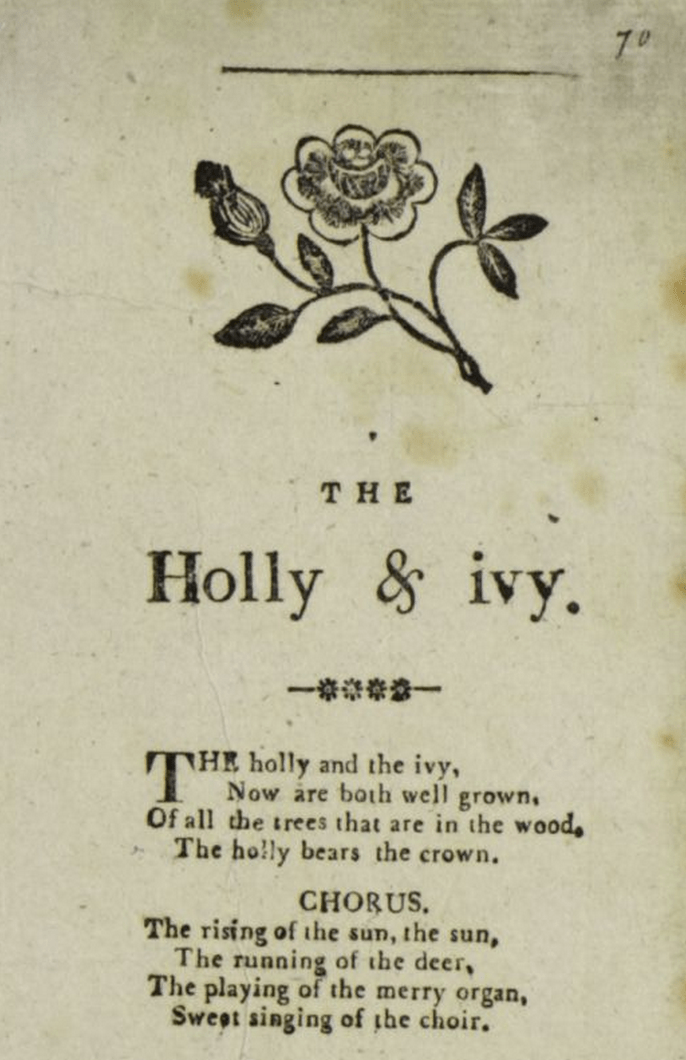
“The Holly and the Ivy” from Medieval English Lyrics


Discover more from Tim Miller

Subscribe to get the latest posts to your email.

Leave a Reply

This site uses Akismet to reduce spam. Learn how your comment data is processed.

#216: Poets, Prophets, Seeresses & Goddesses from Time & the River Human Voices Wake Us

An episode from 2/9/2026: This is the second episode where I read from my upcoming book Time and the River: From Columbine to the Invention of Fire, which comes out on February 23.This time, I read seven of my favorite poems from the point of view of women. They are:Mr Cassian’s Good Friend, Emily DickinsonVölvaSong to SequanaEponaThe Seeress of VixMiriamMorgan le FayAs I mention, more information about the continental Celtic goddesses Equana and Epona can be found in Miranda Green’s Myth and Symbol in Celtic Religious Art. My article on the burial at Vix is in issue #45 of Ancient World.The best way to support the podcast is by leaving a review on Apple or Spotify, sharing it with others, or sending me a note on what you think. You can also order any of my books: Time and the River: From Columbine to the Invention of Fire, due out next year, is now available for preorder. Other books include Notes from the Grid, To the House of the Sun, The Lonely Young & the Lonely Old, and Bone Antler Stone. I've also edited a handful of books in the S4N Pocket Poems series. I also have a YouTube channel where I share poems and excerpts from these books, mostly as YouTube shorts.Email me at humanvoiceswakeus1@gmail.com.
  1. #216: Poets, Prophets, Seeresses & Goddesses from Time & the River
  2. #215: 8 Favorite Poems from "Time and the River"
  3. #214: Two of the Best Poems You've Never Heard of (by William Cullen Bryant)
  4. #213: Van Gogh's Early Years
  5. #212: The Most Popular Story in Ancient India
  6. #211: Who Was William Cullen Bryant?
  7. #210: Memories & Legends of William Shakespeare
  8. #209 – Being a Jew in 1900, Being a Jew Now
  9. #208: Bach & God
  10. #207 – Death, the Gods, and Endless Life in Ancient Egypt

Discover more from Tim Miller

Subscribe now to keep reading and get access to the full archive.

Continue reading