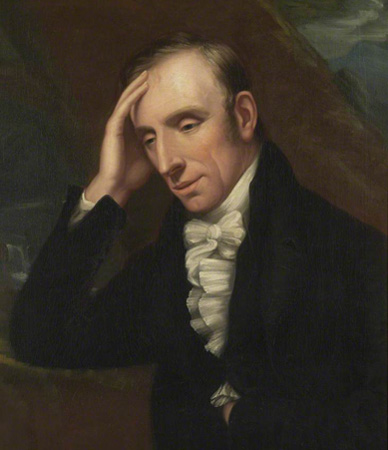
“The world is too much with us”
The world is too much with us; late and soon,
Getting and spending, we lay waste our powers:
Little we see in nature that is ours;
We have given our hearts away, a sordid boon!
This Sea that bares her bosom to the moon;
The Winds that will be howling at all hours
And are up-gathered now like sleeping flowers;
For this, for every thing, we are out of tune;
It moves us not – Great God! I’d rather be
A Pagan suckled in a creed outworn;
So might I, standing on this pleasant lea,
Have glimpses that would make me less forlorn;
Have sight of Proteus coming from the sea;
Or hear old Triton blow his wreathed horn.


London
1802
Milton! thou should’st be living at this hour:
England hath need of thee: she is a fen
Of stagnant waters: altar, sword and pen,
Fireside, the heroic wealth of hall and bower,
Have forfeited their ancient English dower
Of inward happiness. We are selfish men;
Oh! raise us up, return to us again;
And give us manners, virtue, freedom, power.
Thy soul was like a Star and dwelt apart:
Thou hadst a voice whose sound was like the sea;
Pure as the naked heavens, majestic, free,
So didst thou travel on life’s common way,
In chearful godliness; and yet thy heart
The lowliest duties on itself did lay.


“Surprized by joy – impatient as the wind”
Surprized by joy – impatient as the Wind
I wished to share the transport – Oh! with whom
But Thee, long buried in the silent Tomb,
That spot which no vicissitude can find?
Love, faithful love recalled thee to my mind –
But how could I forget thee! – Through what power
Even for the least division of an hour,
Have I been so beguiled as to be blind
To my most grievous loss? – That thought’s return
Was the worst pang that sorrow ever bore,
Save one, one only, when I stood forlorn,
Knowing my heart’s best treasure was no more;
That neither present time, nor years unborn
Could to my sight that heavenly face restore.

William Wordsworth, 1770-1850 – from The Major Works


Discover more from Tim Miller

Subscribe to get the latest posts to your email.

One response

Leave a Reply

This site uses Akismet to reduce spam. Learn how your comment data is processed.

#217: Voices from 1900-1914 Human Voices Wake Us

An episode from 1/2/23: Tonight, I read a handful of voices from those living in Europe and the United States between 1900 and 1914. Rephrased only slightly, nearly all of their concerns (over technology, gender, nationalism, war, eugenics) feel like they could appear in the news or on the street today. Then and now, what is actually going on alongside all the dread? What can we learn from these voices that sound so much like our own, and what will people look back on 2023 learn for themselves?Each of these quotations can be found in Philipp Blom’s wonderful book, The Vertigo Years.The best way to support the podcast is by leaving a review on Apple or Spotify, sharing it with others, or sending me a note on what you think. You can also order any of my books: Time and the River: From Columbine to the Invention of Fire, due out next year, is now available for preorder. Other books include Notes from the Grid, To the House of the Sun, The Lonely Young & the Lonely Old, and Bone Antler Stone. I've also edited a handful of books in the S4N Pocket Poems series. I also have a YouTube channel where I share poems and excerpts from these books, mostly as YouTube shorts.Email me at humanvoiceswakeus1@gmail.com.
  1. #217: Voices from 1900-1914
  2. #216: Poets, Prophets, Seeresses & Goddesses from Time & the River
  3. #215: 8 Favorite Poems from "Time and the River"
  4. #214: Two of the Best Poems You've Never Heard of (by William Cullen Bryant)
  5. #213: Van Gogh's Early Years
  6. #212: The Most Popular Story in Ancient India
  7. #211: Who Was William Cullen Bryant?
  8. #210: Memories & Legends of William Shakespeare
  9. #209 – Being a Jew in 1900, Being a Jew Now
  10. #208: Bach & God

Discover more from Tim Miller

Subscribe now to keep reading and get access to the full archive.

Continue reading