He’s lying in poor water, a yard or so depth of poor safety,
Maybe only two feet under the no-protection of an outleaning small oak,
Half under a tangle of brambles.

After his two thousand miles, he rests,
Breathing in that lap of easy current
In his graveyard pool.

About six pounds weight,
Four years old at most, and hardly a winter at sea –
But already a veteran,
Already a death-patched hero. So quickly it’s over!
So briefly he roamed the gallery of marvels!
Such sweet months, so richly embroidered into earth’s beauty-dress,
Her life-robe –
Now worn out with her tirelessness, her insatiable quest,
Hangs in the flow, a frayed scarf –

An autumnal pod of his flower,
The mere hull of his prime, shrunk at shoulder and flank,

With the sea-going Aurora Borealis
Of his April power –
The primrose and violet of that first upfling in the estuary –
Ripened to muddy dregs,
The river reclaiming his sea-metals.

In the October light
He hangs there, patched with leper-cloths.

Death has already dressed him
In her clownish regimentals, her badges and decorations,
Mapping the completion of his service,
His face a ghoul-mask, a dinosaur of senility, and his whole body
A fungoid anemone of canker –

Can the caress of water ease him?
The flow will not let up for a minute.

What a change! from that covenant of polar light
To this shroud in a gutter!
What a death-in-life – to be his own spectre!
His living body become death’s puppet,
Dolled by death in her crude paints and drapes
He haunts his own staring vigil
And suffers the subjection, and the dumbness,
And the humiliation of the role!

And that is how it is,
That is what is going on there, under the scrubby oak tree, hour after hour,
That is what the splendour of the sea has come down to,
And the eye of ravenous joy – king of infinite liberty
In the flashing expanse, the bloom of sea-life,

On the surge-ride of energy, weightless,
Body simply the armature of energy
In that earliest sea-freedom, the savage amazement of life,
The salt mouthful of actual existence
With strength like light –

Yet this was always with him. This was inscribed in his egg.
This chamber of horrors is also home.
He was probably hatched in this very pool.

And this was the only mother he ever had, this uneasy channel of minnows
Under the mill-wall, with bicycle wheels, car-tyres, bottles
And sunk sheets of corrugated iron.
People walking their dogs trail their evening shadows across him.
If boys see him they will try to kill him.

All this, too, is stitched into the torn richness,
The epic poise
That holds him so steady in his wounds, so loyal to his doom, so patient
In the machinery of heaven.
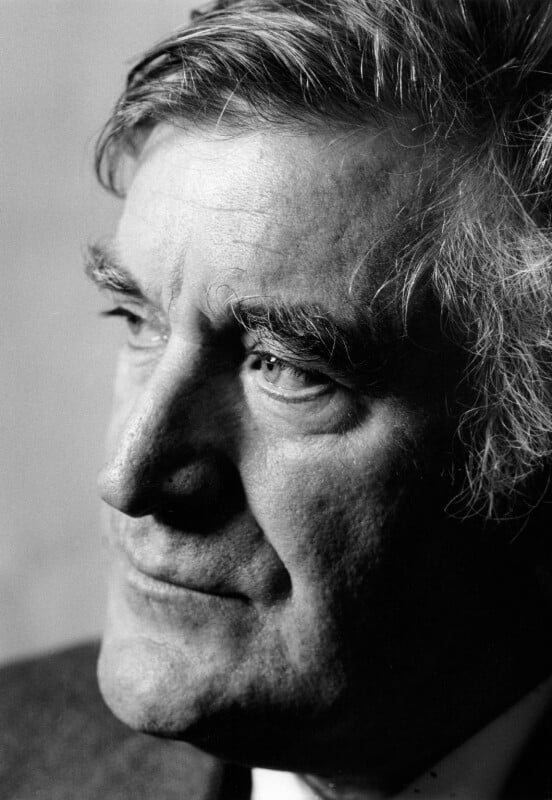
Ted Hughes, 1930-1998 – “October Salmons” from River


Leave a Reply