#222: Seamus Heaney – 10 Essential Poems – Human Voices Wake Us
Six Young Men
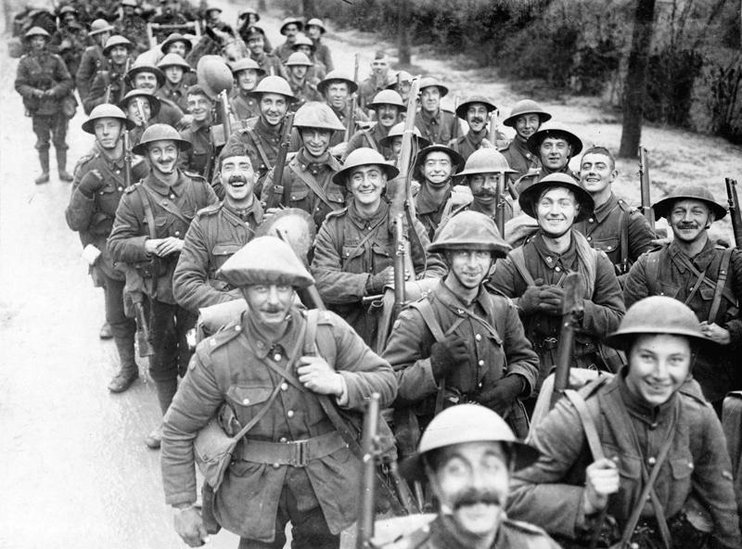
The celluloid of a photograph holds them well –
Six young men, familiar to their friends.
Four decades that have faded and ochre-tinged
This photograph have not wrinkled the faces or the hands.
Though their cocked hats are not now fashionable,
Their shoes shine. One imparts an intimate smile,
One chews a grass, one lowers his eyes, bashful,
One is ridiculous with cocky pride –
Six months after this picture they were all dead.
All are trimmed for a Sunday jaunt. I know
That bilberried bank, that thick tree, that black wall,
Which are there yet and not changed. From where these sit
You hear the water of seven streams fall
To the roarer in the bottom, and through all
The leafy valley a rumouring of air go.
Pictured here, their expressions listen yet,
And still that valley has not changed its sound
Though their faces are four decades under the ground.
This one was shot in an attack and lay
Calling in the wire, then this one, his best friend,
Went out to bring him in and was shot too;
And this one, the very moment he was warned
From potting at tin-cans in no-man’s land,
Fell back dead with his rifle-sights shot away.
The rest, nobody knows what they came to,
But come to the worst they must have done, and held it
Closer than their hope; all were killed.
Here see a man’s photograph,
The locket of a smile, turned overnight
Into the hospital of his mangled last
Agony and hours; see bundled in it
His mightier-than-a-man dead bulk and weight:
And on this one place which keeps him alive
(In his Sunday best) see fall war’s worst
Thinkable flash and rending, onto his smile
Forty years rotting into soil.
That man’s not more alive whom you confront
And shake by the hand, see hale, hear speak loud,
Than any of these six celluloid smiles are,
Nor prehistoric or, fabulous beast more dead;
No thought so vivid as their smoking-blood:
To regard this photograph might well dement,
Such contradictory permanent horrors here
Smile from the single exposure and shoulder out
One’s own body from its instant and heat.
My Uncle’s Wound
Not much remains of my uncle’s Normandy.
The stones, but he’d signed none.
The grass is in its fortieth generation
And the skylines have moved subtly – pampered curves
Of a slut risen in the world.
Under the March washing wind
New wheat tugged and glistened.
We walked up a lane he had last marched up sick
With the black stench of dead men
And the beckoning of shell-burst and mile-off machine-gun –
He monologued the march he had come
Sleepwalking in the khaki familiar column,
Singing, but inwardly one silent eye
Seeing for the first time the crazed eyes of men
Once blown to pieces then reassembled
Hurriedly and healed with a cigarette –
The river of stretchers, bandages, crutches and blood
Oozing down from the trembling ridges
Where the twentieth century broke surface
And the machine guns transformed mathematics.
I was squeezing myself into the ditches
Reading my final moment off grassblades
Or the untroubled procedure of beetles,
Or else floating gingerly at head-height
My neck bare to the chill of an express track
Along which the vistas exchanged lightnings.
The fields, as they changed, were still finding dead men –
Richer dark patches in the pale watercolour wheat.
I scavenged for a memory, crumbs of rust or of bone
In one dead man’s shadow of fertility.
But I found nothing and maybe they weren’t dead men.
And when I looked at my uncle, to see in a glass
The landscape as it had been,
He had turned to a wandering bit of a dream.
It was a cold-eyed country, up and earning
Daily bread in a thoroughly wakened world.
He seemed certain only of the low wood
Bristling the ridge – in the first mist of bud –
Towards which we were walking and towards which
Long ago, he had started to run
Sketchily with some tentative others when
A bullet picked him up by the hip-bone
And laid him in a shell-hole. The sun
All the remainder of a day stared down
Into his wound. The war had gone
Away and left him alone
With a deliberate sniper who now signed
His brow with blood, and as that shrank him flat
Below the crater wall, bullet by bullet
Dug down after him and signed him again.
I wanted the exact spot – the earth-scar of that hole
Through which he bloodily crept into wealth and fatness.
I would have put in my wallet
One of the green-flagged thread-root wheat grains
Of his resurrection.
He’d lost touch – it was all “Somewhere down there.”
Somewhere or other in time, somewhere in him.
As the world’s mass kept those skylines so quiet
He became quiet
With his memories. But I know memory
As I know the blood-crammed dried out rabbit-coloured
Crumbs of soil that thicken this earth,
Or the blinding of the sun, or the green wheat blades
Sucking the crumbled soil
Into their glistenings.